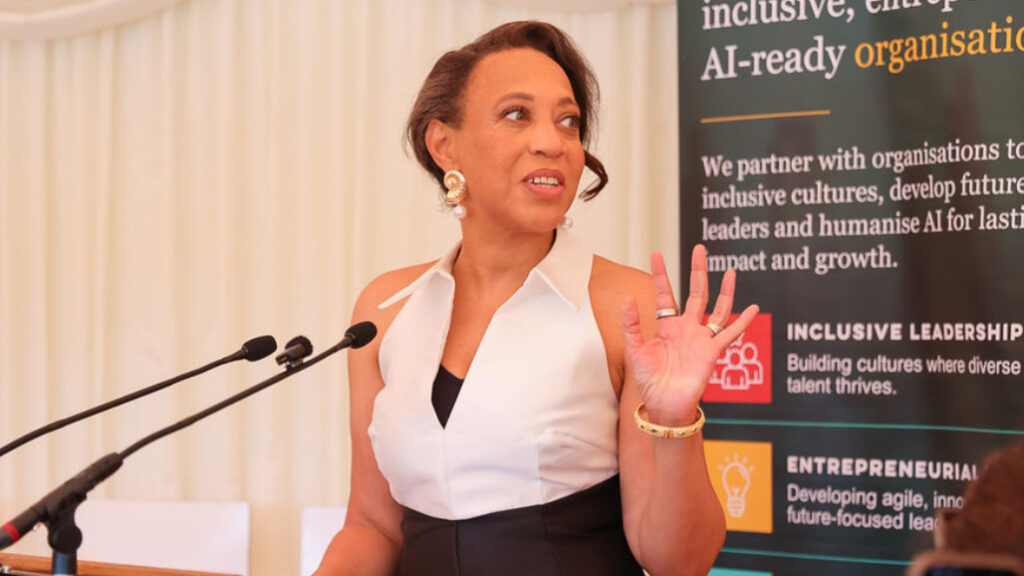
When Jenny Garrett OBE was a little girl, growing up in social housing in London, she pored over fashion magazines, dreaming one day of creating outfits that would grace the runway. While a future filled with fabric samples and sewing machines was not Garrett’s future, her life’s work has been concerned with supporting those to embrace their best selves through leadership, financial literacy and language.
Today Garrett is the founder and CEO of Jenny Garrett Global, an award-winning leadership consultancy she started in 2006. At the core of her work is the belief that “potential is everywhere, but opportunity is not, and the work of leadership is to close that gap”.
Garrett is the author of several books, including Rocking Your Role about female breadwinners, Equality vs Equity looking at fairer workplaces and AI for Equity, along with her daughter Leah-Sunshine Garrett, which examines how AI can build a fairer society and will be out in October 2026.
She received an OBE in 2021 for services to entrepreneurship and women in business and was appointed as a Companion of the Institute of Leadership and Management. She founded the UK’s first Diverse Executive Coach Directory and co-founded the social enterprise Rocking Ur Teens CIC, which has reached over 3,500 young people.
Garrett’s road to leadership coaching was spearheaded by a bit of mentoring from a former colleague when she worked as a marketer. The co-worker commented that Garrett could have larger ambitions than her current role.
“People come into your office, they come away motivated, they come away with actions,” she was told. This prompted Garrett to pursue a role in coaching.
Garrett offers several bits of advice for women looking to advance and focus their careers. First, she advises that women “be adaptable and flexible,” understand how they can bring in new ideas and build their resilience.
“I encourage women to develop their entrepreneurial skills to succeed in the AI driven workplace, even if you’re employed as a treasury professional,” to understand that is to understand how to be adaptive, she added.
The second is to “know your worth”, by noting down actions and projects and pointing out the difference they make to an organisation, said Garrett.
“Too often, when we have great skills, we take them for granted, and we think everyone can do that,” she added. “Oh, everyone’s a great negotiator, or everyone spots those errors that would have cost us millions.”
This is something women need to get better at, Garrett said, making that connection between what they do and how valuable it is to the organisation.
The third is to hold the space around ideas. This means holding space around communication and reinforcing it with three points. Garrett added that it is important to “make your point, explain it three times, three different reasons, and make your point again”.
Finally, she points out that women should not be afraid to use assertive language to remain visible and to get their points across well.
Many young men in business Garrett comes across are “generally more open and understanding of the female experience”. However, while that “is really wonderful”, “women’s lives and women’s experiences are quite different”.
She still meets women who talk about the difficulties of speaking about female health issues that could impact work, with male bosses or colleagues, because they often “change the subject, or they just don’t understand”.
More senior men need to be willing to stand up and say, “we need women, and we need to support women, we need to advocate for women,” said Garrett. However, she is also witnessing “some fragility” from men when they are called out to be allies or “do more”.
“It’s that sort of, ‘not all men’, it’s definitely not me, it’s the others,” she added. “And sometimes not recognising that it actually could be you because ‘it’s the system’, it’s not you personally.”
Garrett commented that she often hears that much of the work around gender parity is “done”. People comment that “isn’t it fair already? I see women everywhere. They’re all bossing it,” she added.
Organisations often find themselves with a triangle-shaped talent pool, where there is diversity at junior levels, but at senior and board levels the so-called “glass ceiling” is still holding strong, she added.
However, Garrett sees organisations that had been truly committed to diverse hiring, inclusive cultures and equitable opportunities are still doing the work of so-called DEI (diversity, equity and inclusion) programmes. This despite some well-publicised backlash to the initiatives.
“The ones who were ticking a box and just did the old ‘One hour workshop’ and moved on have [stopped the work]”, said Garrett. “It’s disappointing for some in organisations when they’ve seen their organisation roll back. However, DEI-type work continues to get done,” she added. “They might call it something else, but they continue to do that work.”
“I would say, there’s no excuse not to continue doing the work; there is no excuse, whatever we call it, whether we call it DEI, whether we call it culture, whether we call it inclusion, whether we call it fairness,” said Garrett. “There’s no excuse not to do the work because we identified that there is an inequity in society and therefore in our workplaces, and we haven’t fixed it.”
In her book, Equality vs Equity, Garrett quoted American lawyer, legal scholar and civil rights activist Derrick Bell, who said racism and all other ‘isms’ are constantly shape-shifting.
“Things shapeshift,” she said. “But the problem is still there, and ultimately, we shouldn’t be disheartened.”