

Insight & Analysis

A new era for interest rate markets

Published: Aug 2026
ECR Research logo

The playing field for interest rate markets has changed, and this means that capital market interest rates will behave differently from what we have become accustomed to over the past few decades.

Percentage sign on graph.

Up until the year 2000, there was downward pressure on prices and there was even a risk of deflation. The deflationary pressure stemmed mainly from technological innovation and the rapid expansion of production capacity in Asia. As a result, the supply of goods there rose much faster than demand. The surplus was exported at low prices, which put downward pressure on import inflation, particularly in Europe and the US, and meant that real wage increases in Europe and the US remained relatively low due to import competition. Deflation would be disastrous for many highly indebted economies, which is why, at that time, an increasing number of central banks began to pursue a loose monetary policy. This was particularly the case during times of crisis, as a fall in demand immediately led to a supply surplus. This allowed central banks to open the monetary taps wide without having to fear excessive inflation.

Gradually, however, this has changed. To begin with, more and more countries are using import duties to shield themselves from these cheap imports. This is a trend that is only set to intensify. Furthermore, the war in the Middle East has caused companies to reassess where they have their goods manufactured or sourced from. The security of supply routes now plays a much more important role. This means that production no longer necessarily takes place where it is cheapest. Consequently, this leads to higher prices.

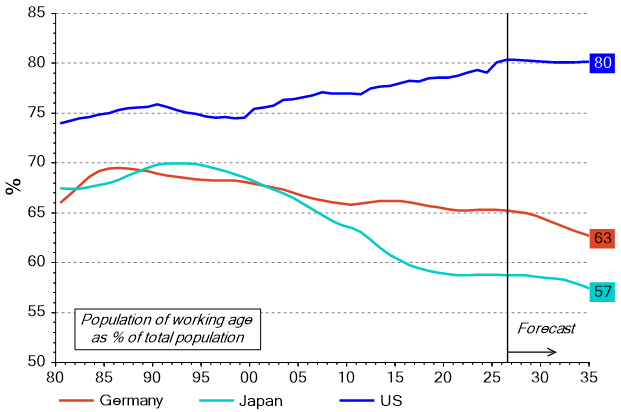
Another key point is that the ageing population is now really starting to have an impact in the West, as well as in China and Japan. As a result, labour markets are becoming tight much sooner than in the past, leading to rising wages. This is all the more so given that resistance to immigration is growing almost everywhere.

Chart 1: Demography no friend of the economic outlook

Source: LSEG Datastream/ECR Research

The extent to which this drives up inflation through higher wages depends heavily on what happens to productivity growth. The hope is that the use of AI will raise productivity growth to a structurally higher level. However, an increasing number of experts are becoming sceptical about the extent to which this will happen sufficiently across the economy, at least in the coming years. This is because there are many sectors where AI is not yet widely used or leads to few efficiency improvements. Furthermore, it often takes several years before new technologies are properly implemented. In other words: from the perspective of labour costs too, the climate has shifted from lower to higher prices.

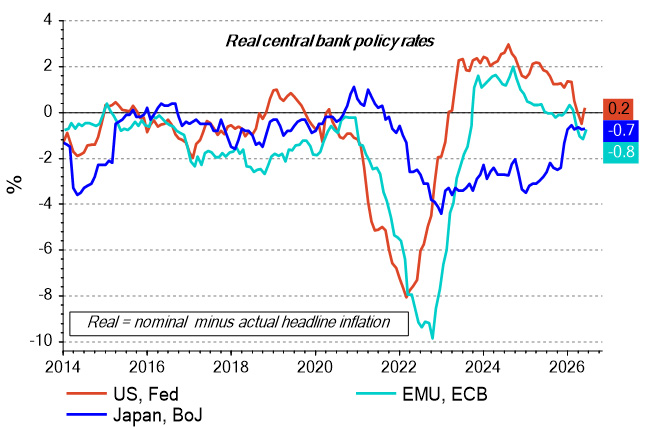
Against this backdrop, loose monetary policy and/or supply shocks are exerting upward pressure on inflation to a greater extent than in recent decades. At present, both factors are at play. Monetary conditions are now very accommodative, as evidenced by low credit spreads, high share prices and real interest rates that remain relatively low. These accommodative monetary conditions are stimulating economic growth and are a key reason why inflation has been at or above the Fed’s and the ECB’s targets for several years now.

Chart 2: By keeping the short term real rates low to negative cental banks are adding to the inflationary pressures

Source: LSEG Datastream/ECR Research

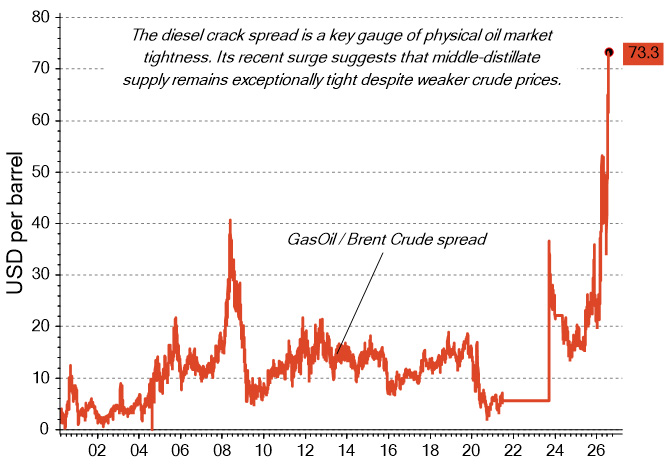
The ongoing tensions in the Middle East and the blockade of the Strait of Hormuz are causing a supply shock in the form of higher oil prices. This is exacerbated by the fact that many refineries in the Middle East are partially shut down and an increasing number of Russian refineries are being bombed. As a result, diesel and petrol prices have risen even more sharply. The risk is that oil stocks have now dwindled to such an extent that a prolonged blockade of Hormuz will also lead to crude oil shortages, causing energy prices to rise even further. Oil shortages could also lead to reduced production.

Chart 3: European crack spreads are surging

Source: LSEG Datastream/ECR Research

Furthermore, many meteorologists are anticipating a super El Niño, which could lead to additional drought in some parts of the world and flooding in others, likely causing food prices to rise.

As a result, it has become more difficult for central banks to keep inflation low. It is possible to do so, but this requires a tighter monetary policy, which would put a significant brake on the economy. As economic growth is relatively low due to an ageing population and reduced immigration, this could easily lead to a recession, causing high levels of debt to weigh heavily on the economy once again. There is also increasing political pressure on central banks to keep interest rates low. This is fuelling growing doubts among bond investors as to whether central banks will be able to keep inflation under control. Consequently, investing in longer-dated bonds is becoming riskier, prompting investors to demand a higher risk premium in the form of higher interest rates.

Furthermore, bonds have become less attractive to investors as a safe-haven asset during crises. This is because it is not automatically the case that, in a crisis, inflation falls sharply and central banks open the monetary taps and buy bonds on a large scale. For foreign central banks, there is the added factor that it has become riskier to hold large amounts of money in US and/or European capital markets now that the freezing of Russian assets has been used as a political tool.

As a result, we expect capital market interest rates to rise further in the coming quarters and that, in the event of a future crisis, capital market interest rates are likely to fall less sharply than we have seen in previous crises. Central banks will also have less scope to cut interest rates, as this could be interpreted by the bond markets as an inflationary policy, leading to higher capital market interest rates. As the negative impact of higher capital market interest rates on the economy will quickly outweigh the positive impact of lower short-term interest rates, central banks will then quickly opt for the lesser of two evils and exercise caution with rate cuts as long as inflation remains above the target level.

Join our global community

Creating a free account helps us to understand our community better, and tailor our content and events to suit your needs. You can unsubscribe at any time.

Already have an account? Sign in

Search for your company; if not found, select 'Other' and enter it manually below
  • • At least 8 characters
  • • At least 1 uppercase letter (A-Z)
  • • At least 1 lowercase letter (a-z)
  • • At least 1 digit (0-9)