
Insight & Analysis

Markets overprice European rate rises; dollar strength set to persist

Published: Jun 2026
ECR Research logo

Corporates remain wary of energy costs and inflation, but ECR strategists argue markets are overpricing European rate rises amid weak growth. In contrast, resilient US fundamentals and higher yields continue to underpin dollar strength against the euro, for now.

Euro and US dollar notes arranged as shapes.

The US, Iran and Israel are currently negotiating an end to the war. A key aspect of this is the extent to which Iran remains capable of developing a nuclear weapon. This is something the US and Israel are determined to prevent, but which Iran sees as necessary to continue playing a significant role in the Middle East and to avoid being attacked again.

However, what interests the markets most is when the Strait of Hormuz will reopen and to what extent. If the strait is not fully opened within a few weeks to months, physical shortages of oil, gas, helium and fertiliser will arise and their prices will skyrocket. For many countries, this would mean higher inflation and interest rates, as well as lower economic growth, if not recession. This is something that must be handled with great care, as high levels of debt could easily lead to a new credit crisis.

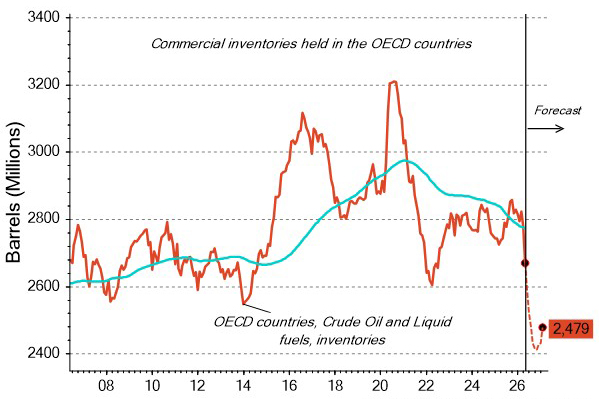
In many countries, oil stocks are now rapidly approaching critical levels below which physical shortages will arise. Moreover, this also means that, even if the Strait of Hormuz were to open tomorrow, many experts expect it would take until the first half of 2027 before the old supply-demand balance is restored due to replenishing stocks and a likely slow restart of oil production.

Chart 1: OECD oil reserves

Source: LSEG Datastream/ECR Research

As a result, we expect that central banks are unlikely to react strongly in the short term to the lower or higher inflation figures that may be expected in the coming months. Let’s first see how inflation figures develop further.

End of the Strait of Hormuz blockade

It is good that negotiations are now underway, but in our view, Iran has little interest in striking a deal quickly at this stage. It seems more logical to us that Iran will keep the Strait of Hormuz fully or partially closed for a further few weeks to months. Energy prices will then rise further, inflicting more economic damage to the US and its allies, so that Iran may extract even more concessions from the US and Israel.

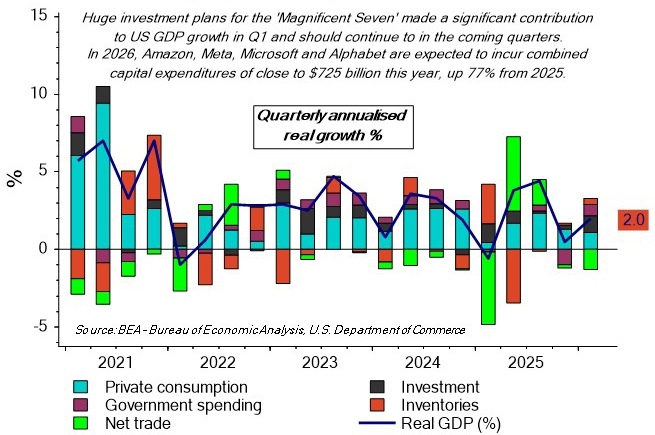
We assume this means that the oil price will not fall significantly for the time being and will likely rise again. It is then primarily the Fed that will have to consider raising interest rates. The enormous increase in investment in AI seems set to continue providing a significant boost to the US economy for the time being. The same applies to the positive wealth effect resulting from high share prices and property prices. Moreover, credit spreads remain low and the dollar exchange rate is no longer particularly high. In our view, all these factors carry more weight for economic growth than the now-expiring fiscal stimulus, the slight decline in real purchasing power and a relatively low savings rate.

Chart 2: The US economy expanded by an annualised 2% in Q1 2026

Source: LSEG Datastream/ECR Research

In Europe, at any rate, this is much less the case. There, the decline in real purchasing power weighs much more heavily and investment growth is considerably lower. Moreover, if the oil price does indeed not fall much lower for the time being, this will suck a great deal of purchasing power out of Europe. Something that, incidentally, also applies to Japan. In both cases because they have to import a lot of oil and gas.

Euro/US dollar

As for what this means for EUR/USD, our starting point is that, for a number of reasons, the dollar is currently a weak currency:

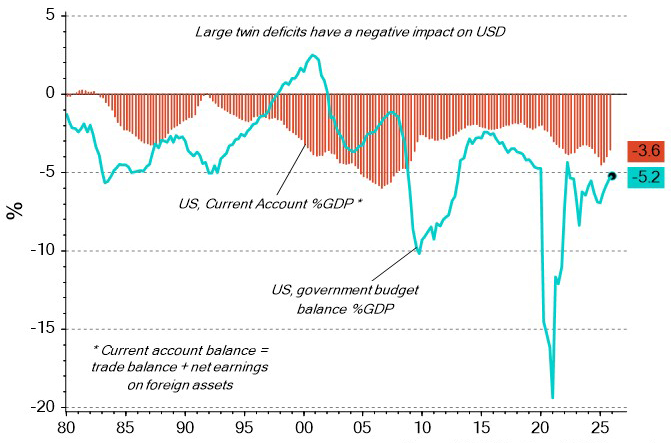
  • The US has large deficits in public finances and the current account (so-called twin deficits). This means the US must import a great deal of capital from abroad if the dollar is not to fall in value.

  • In principle, the US currency can also count on substantial capital inflows, as the dollar is by far the world’s most important reserve currency. However, Washington is pursuing a policy that makes many managers of large reserve funds wary of investing heavily in dollars.

  • Major suppliers of capital to the US are the countries in the Middle East, Japan and China. However, following the recent hostilities, the countries in the Middle East must invest heavily in the restoration of oil infrastructure and defence. In Japan, deflation has turned into inflation, causing interest rates to rise sharply. As a result, capital exports from Japan have fallen sharply, if not turned into capital imports. Finally, in the case of China, geopolitical relations with Washington have deteriorated significantly, making it risky to invest heavily in the US.

Chart 3: US current account %GPD & budget balance %GDP

Source: LSEG Datastream/ECR Research

As a result, we expect the US to face increasing difficulty in the coming years in continuing to finance its twin deficits at relatively low interest rates whilst simultaneously keeping the dollar strong. The less foreigners are willing to invest in the US, the more the US will have to make this attractive by offering higher interest rates and/or allowing the dollar to weaken. As the US cannot sustain (much) higher interest rates for long due to its high levels of debt, we expect that the preference will be for a weaker dollar.

However, all this may be overshadowed in the short term by a number of other factors:

  • As long as foreign investors remain keen to invest money in the US, the relatively higher interest rates in the US work in the dollar’s favour.

  • In the event of rising geopolitical tensions, the US is generally seen as a safe haven.

  • In the field of AI, the US is certainly ahead of Europe. This may make it more attractive to invest in the US than in Europe. This is certainly evident in the equity markets at present.

  • We expect the Strait of Hormuz to remain closed for longer than investors had priced in at the end of May, and that energy prices will consequently rise. The US economy is less affected by this than the European economy. Even if the Strait were to open tomorrow, we expect oil prices to fall, but on balance to remain higher than before the Iran war.

Against this backdrop, we believe that the markets are currently pricing in too much of a rise in interest rates in Europe. Of course, higher energy prices will also push up inflation in Europe, and the ECB will likely respond by raising interest rates. However, the central bank itself is forecasting economic growth of around 1% through to the end of 2027, with the greatest risks on the downside. If energy prices do indeed remain high for the time being, growth is likely to be closer to 0.5%. This does not seem to us to be an environment in which to expect persistently high inflation. We therefore consider it highly likely that the ECB will raise interest rates by less than is currently priced in. For the Fed, the situation is exactly the opposite.

Our conclusion is that, in the coming period, we see the positive factors for the US dollar against the euro outweighing the negative ones. That is why we do not expect EUR/USD to rise much above 1.18 in the coming months and, on balance, see it slipping towards 1.05-1.10.

Join our global community

Creating a free account helps us to understand our community better, and tailor our content and events to suit your needs. You can unsubscribe at any time.

Already have an account? Sign in

Search for your company; if not found, select 'Other' and enter it manually below
  • • At least 8 characters
  • • At least 1 uppercase letter (A-Z)
  • • At least 1 lowercase letter (a-z)
  • • At least 1 digit (0-9)