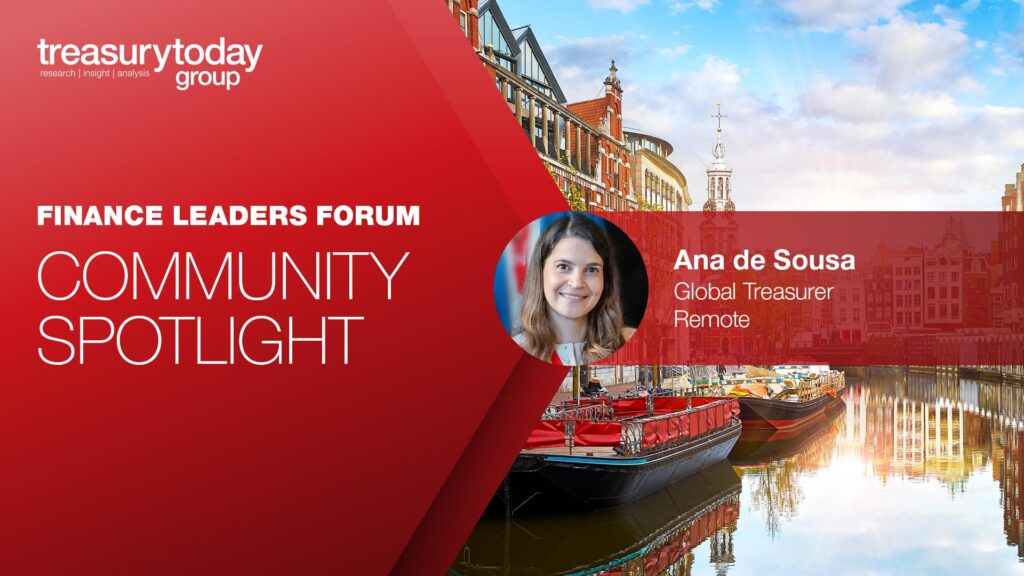
Ana de Sousa, Global Treasurer at Remote, who attended the 2026 Amsterdam chapter of our Finance Leaders Forums, is driven by curiosity, an understanding of how things work and getting things done. She sees treasury as a function without walls, where expertise creates value throughout the business.
What did you want to be when you grew up?
I’m the youngest of four children, and my childhood was not always easy. I don’t remember having one clearly defined career in mind. More than anything, I wanted to build a life in which I could be happy, independent and have choices.
For a while, I thought about becoming a teacher because I valued learning knowledge, but I especially valued the people who helped me access it and see the world differently. I eventually became a lecturer at the university because that curiosity has stayed with me. I still love learning, understanding how things work and being challenged by new ideas.
Looking back, curiosity has probably been one of the strongest threads running through my entire career.
How did you start your career in treasury?
My career began not in corporate treasury, but in banking regulation. In a way, I started on the other side of the table: understanding risk, questioning assumptions and looking at the systems and controls behind financial decisions.
The turning point came after I completed my degree in risk management and moved to Switzerland. Switzerland is one of the world’s most established financial centres, and being immersed in that environment opened the door to treasury. What attracted me to, and kept me in, the profession was its combination of analytical thinking, problem-solving, negotiation and tangible business impact. I enjoy a difficult negotiation, I like understanding how things work, and I am very focused on adding value and getting things done. Treasury turned out to be a natural fit.
One of the interesting things about my career is that I have always worked closely with banks, but never for one. First as a banking regulator and later as a treasurer. Treasury is also a profession people enter through many different doors. That diversity of experience is one of the things that makes the treasury community so valuable.
Eventually, that journey led me to build the treasury function at Remote. My approach was always about getting things done and simplifying complexity but never taking shortcuts with the foundations.
We started by centralising treasury through Kyriba. That foundation allowed us to build everything that followed: a more effective investment strategy, an internal cash pool and increasing levels of automation. Later came our hedging programme and the use of AI within treasury. Each layer made the next one possible. Innovation is valuable, but only when it is built on strong foundations.
What is the most exciting part of your day?
The moment when something complicated becomes clear and starts moving forward.
Running treasury for a business that operates across 120+ countries and 60+ currencies means no two days look the same. That scale is part of why I find the work interesting, and it’s exactly why I care about getting the foundations right, because complexity you haven’t designed for will find you eventually.
There’s real satisfaction in taking a problem like that, cutting through the noise and turning it into an outcome. I also enjoy working with people who challenge my thinking and who I can learn from. I’m naturally very results-driven, but I’ve learned that how you achieve the result matters just as much as getting there.
I also enjoy working with people who challenge my thinking and from whom I can learn. I am naturally very results-driven, but experience has taught me that how you achieve a result matters just as much as achieving it. The best outcomes are not only effective; they also strengthen trust, improve how people work together and make the next challenge easier to solve.
What has been your biggest personal challenge?
Probably learning to balance intensity with ease.
I grew up with a strong instinct to fight, work hard and never give up. That resilience has served me extremely well. It helped me overcome difficult moments and take on challenges that might otherwise have felt too big. But over time, I have learned that not everything needs to become a battle and that not every problem deserves the same amount of energy.
But it took me a long time to name this aspect. Being direct is read differently depending on who is being direct. The same conversation that would be called decisive in someone else gets taken personally by another, and I’ve spent a lot of energy over the years on perception. Tough, but not too tough. Clear, but not unlikeable. Emotional intelligence has therefore been an important investment for me. It has helped me understand people better, choose where to focus my energy, and achieve difficult things without creating unnecessary friction. This has not meant becoming less ambitious or demanding. It has meant becoming more intentional about how I lead and pursue results.
I am still very intense when it comes to getting things done. I invest that intensity in building smooth processes and creating a proactive environment instead of constantly reacting to problems. Once that structure is in place, I can enjoy the calm it creates, the space to step back, look for inspiration and think about what should come next.
I also have two children who are very much my purpose. They know that mummy loves her job, and I want them to see that ambition, family and enjoying life do not have to be competing ideas. Finding that balance is something I continue to work on and probably always will.
What has been one of the biggest challenges for the industry over the past few years?
The pace and volume of change. The need to absorb that change without losing control, judgment or sight of what genuinely creates value.
Treasury teams are managing increasing operational, regulatory and financial complexity while being expected to become faster, more strategic and more efficient. For me, one of the greatest opportunities within that challenge is automation and AI. I have very little appetite for repetitive manual work when technology can do it more accurately and efficiently.
Automating routine work creates space for people to focus on judgement, relationships, negotiation and strategic decisions. These are the areas where we can make a real difference. However, technology should support accountability, not replace it. The challenge is to modernise without losing the discipline and integrity that treasury requires.
In treasury, decisions are rarely as simple as being right or wrong. They are usually about finding the right balance between risk, speed, cost and opportunity. That balance must support the business’s goals, but never at the expense of our values. When things become difficult, integrity is non-negotiable.
Has there been someone who inspired, mentored or supported you in your career? What did they do and how?
I have been fortunate to learn from many different people rather than having only one source of inspiration. However, one mentor shared a phrase that has stayed with me throughout my career: fortune favours the bold.
I do not interpret that as simply relying on luck. Luck is often created through hard work, optimism and the courage to act. You prepare, remain open to possibilities and put yourself in a position where opportunities can find you. Sometimes you also need to take a step before you feel completely ready.
The people who have had the greatest impact on me are those who generously shared their knowledge, challenged me and trusted me with opportunities outside my comfort zone. I particularly value people who are honest about both what they know and what they do not know, because that openness creates space for genuine learning.
I can identify an important lesson from every manager I have worked with. Some taught me the power of letting go and trusting others. Some showed me how much creativity treasury require when solving problems that initially appear impossible. Others taught me that achieving the goal matters, but valuing the people around you matters just as much.
Together, those lessons have shaped both the professional and the leader I am today. They have also made me conscious of my responsibility to create those same opportunities for others.
What can senior leaders do to inspire others?
Give people real opportunities, not just advice. Empowering and inspiring others is one of the greatest legacies we can leave. And be deliberate about who gets those opportunities. I’ve spent most of my career in rooms where I was one of very few women, and what made the difference was never someone offering me advice. It was someone handing me something difficult.
Advice can be useful, but trust and responsibility are transformational. I believe in surrounding myself with smart people who are willing to act, learn and take ownership. Many things that initially appear impossible become possible when capable people bring enough willingness, curiosity and persistence.
My role as a leader is to establish clear guidelines and principles and then give people the space to drive the work, knowing that I am there to support them. Leadership is not about having every answer or controlling every step. It is about creating clarity, setting the standards and helping people succeed.
People are also inspired by authenticity and consistency. Leaders should set high expectations, but they must create an environment where people can learn, challenge ideas and occasionally get things wrong without becoming afraid to act.
I rarely see failure as the final answer. What initially feels like failure is often a setback, a lesson or an invitation to find another route. Resilience is built by doing difficult things, not by avoiding them, but people are much more willing to take on those challenges when they know their leaders genuinely support them.
What is next for you?
More scope, more impact and more learning. And, hopefully, more enjoyment along the way.
I increasingly see treasury as a function without walls. The expertise may sit within treasury, but the value we create should extend far beyond it. Treasury teaches us to think about risk, opportunity and value at the same time, and that mindset can contribute much more broadly to the finance and business agenda.
For me, progression means increasing the scale and significance of the problems I can help solve, not simply increasing the size of my team.
At the same time, my definition of success has evolved. I remain ambitious and still want to achieve a great deal, but the goal is no longer simply to do more. It is to bring intensity when it matters while creating more ease in the rest of life. To keep progressing and challenging myself while protecting time for my children, the people and things I love, and my own curiosity.
Ultimately, I want not only to be proud of what I build, but also to enjoy building it.