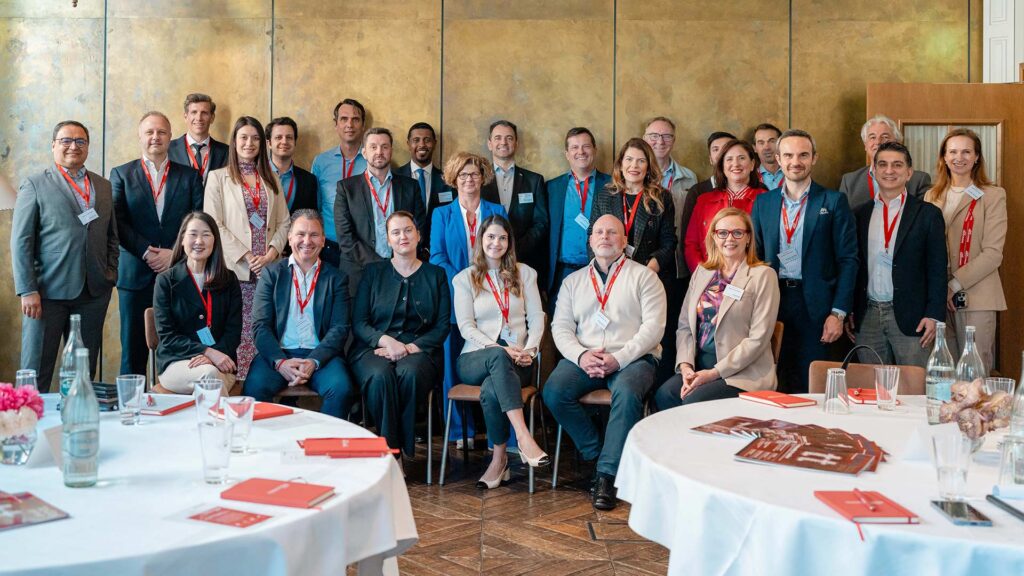
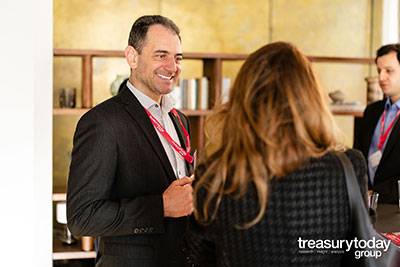
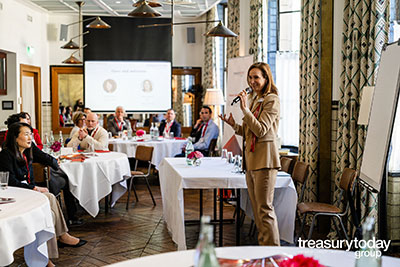
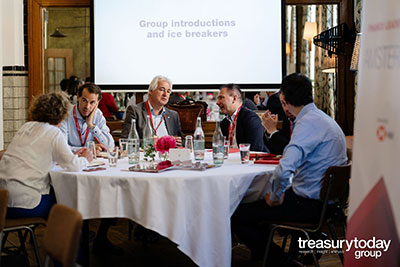
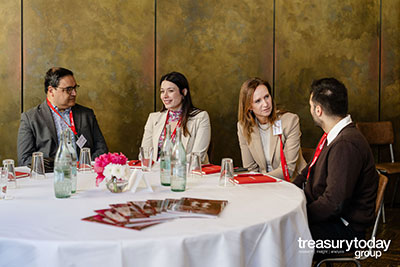
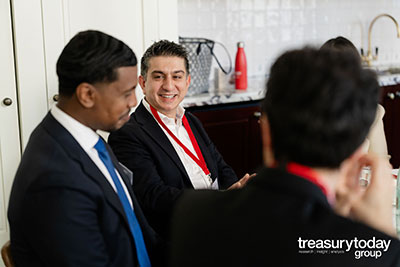
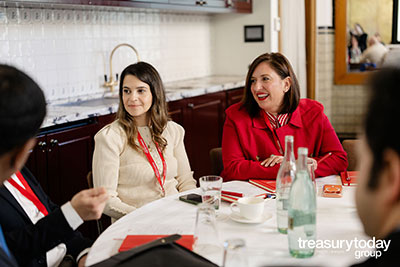
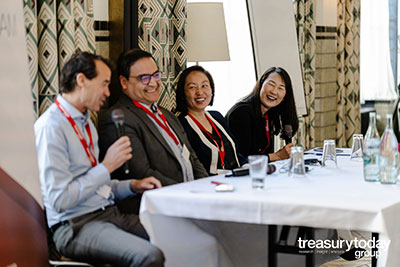
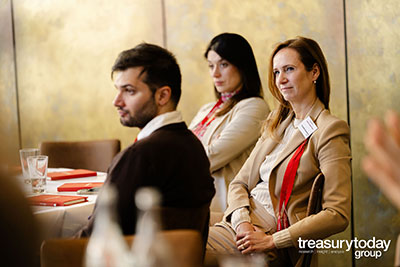
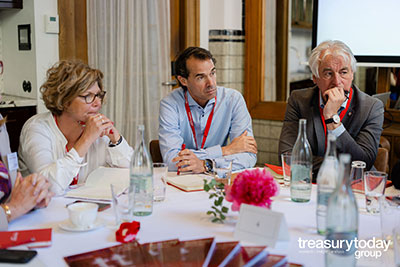
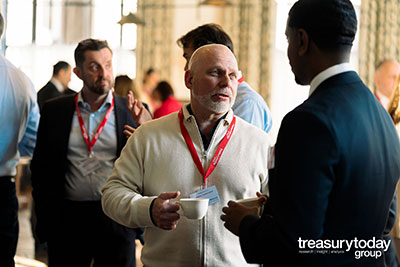
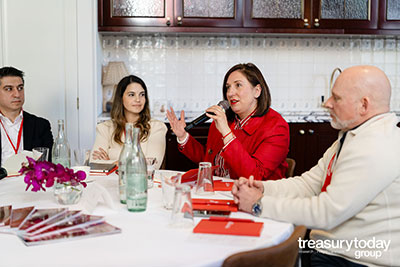
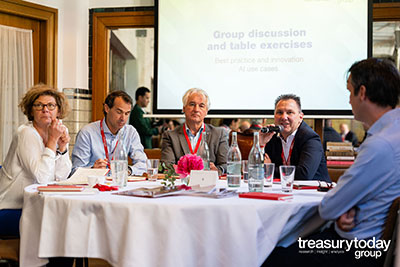
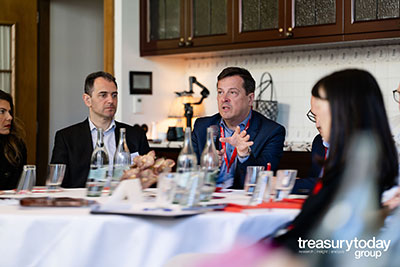
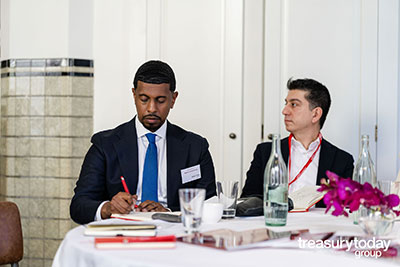
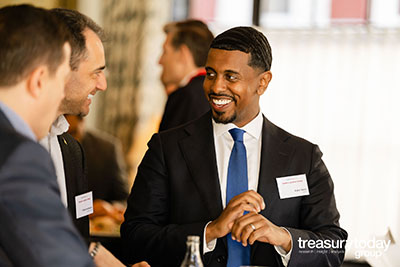
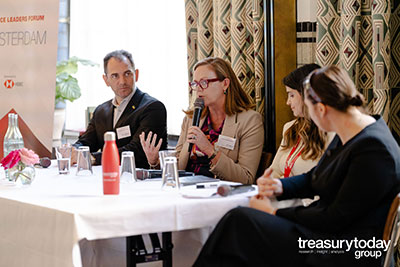
On 22nd April, treasury practitioners, finance leaders and alumni of our awards programmes came to Soho House in Amsterdam for Treasury Today Group’s first Finance Leaders Forum of 2026.
The event, which was sponsored by HSBC, included two thought-provoking panel discussions with industry experts, as well as group exercises focusing on best practice, leadership and wellbeing.
Community and connectivity
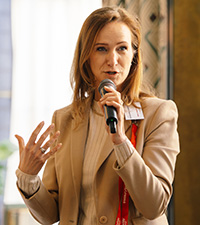
Opening the event, Sophie Jackson, CEO of Treasury Today Group, welcomed attendees, explaining that the aim of the event was to “celebrate best practice, but also create a community based on sharing and building connections with your peers – not just in this room, but across the world.”
Jackson introduced Annabelle Diepenhorst, CEO of HSBC The Netherlands. Diepenhorst highlighted the importance of having a global view. “In this time when there’s a general trend for countries and continents to become more inward-looking, that global connectivity becomes increasingly important,” she reflected.
Next, Jackson invited those in attendance to discuss their goals for the event, and their experiences of 2026 so far. Attendees spoke about challenges, uncertainty and the difficulties involved in trying to navigate world events.
Evolution of treasury and finance
Focusing on the evolution of finance and treasury, the first panel discussion was led by Debbie Kaya, a treasury consultant and a former treasurer with over 30 years’ experience in the technology industry.
Kaya was joined by Alexander van den Heuvel, Director Treasury Operations at dsm-firmenich, Barış Gökalp, Director of Treasury at Şişecam and Yang Xu, CFO of JDE Peet’s.
Xu spoke about the company’s recent transaction with Keurig Dr Pepper. “Basically, the American company is merging with the Dutch listed entity, but subsequently spinning off into two companies – a beverage company, and a coffee group,” she explained. “This has been an interesting time, which has involved issuing €16bn of debt to acquisition done – and now we’re looking forward to getting spin-ready.”
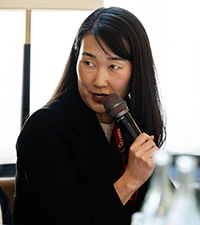
Kaya asked Gökalp about his previous success in the Adam Smith Awards, having been named Highly Commended Winner in Best Cyber-Security Solution in 2021, and Corporate Treasurer of the Year in 2025.
Gökalp spoke about Şişecam’s company’s digital treasury transformation, with highlights including a significant bond issuance, as well as becoming the first corporate in Türkiye to obtain a unique Swift code. Other notable achievements include implementing a treasury management system – another milestone among Turkish corporates – and introducing an in-house banking operation in the UK.
Van den Heuvel, another Adam Smith Awards winner, spoke about the current main priorities for Treasury at dsm-firmenich being the separation of one of the four business units, and the treasury management system project.
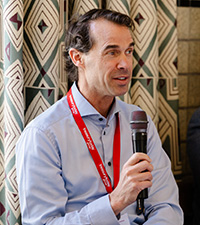
He noted that his team’s success in the Adam Smith Awards has proved helpful in discussions with the CFO: “The fact that we’ve received awards helped us make the claim that we are good at running projects, and that we are credible when bringing a next project to his attention. Of course, it’s not the only thing that matters – but it really helps to be able to say, ‘We’ve done this before, and we are confident that we can do this again.’”
Keeping on top of risk
The panellists spoke about the current risk environment. Xu pointed out that while “everyone’s talking about how volatile it is”, there have been many other periods of volatility in the last 15 years.
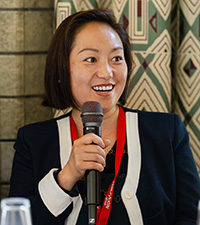
“The one thing I’ve learned is to be very wary about balance sheet management – particularly in good times, because you can negotiate much better covenants, and you can train the team on good balance sheet management,” she said.
She added that challenging times are the moments when treasurers can shine, “because at the end of the day, cash is king and liquidity is the bloodline of any company. So those are the moments to take the bull by the horns.”
Van den Heuvel agreed that it’s essential to be prepared for times of difficulty, noting that his company had issued a €1.5bn bond mid-February, “so that was perfect timing given the start of the Iran war later that month.” Where FX is concerned, he said market conditions do not significantly affect his team as the company’s approach for his area is: “to hedge risks resulting from sales and purchases at the moment of recognition of the receivables and payables.”
Gökalp spoke about supply chain health and explained how the company’s supply chain finance programmes enable the company to support key suppliers. “When the Ukraine-Russia crisis began, and the oil price jumped, we directly made an early payment to our logistics companies to help them manage their fuel oil expense,” he added.
He also highlighted the importance of communicating well with Eurobond and stockholders and stakeholders. “Even in hard times, we give them information, we tell the story of what’s going on and what’s coming and what will be done.”
Harnessing AI
Turning to the topic of AI, the panellists expressed some reservations about how much can be achieved with this technology. Van den Heuvel said he had excluded AI from a treasury management system (TMS) project in this phase, “because my goal is to successfully implement the project and then I’d rather have a more focused scope (instead of overpromising). In a next phase, we should certainly pivot to AI and only then add this on top.”
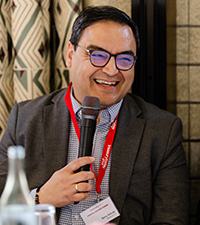
Gökalp said that while his team does use Microsoft Copilot, the main issue when it comes to implementing AI in treasury is that treasury data comes from many other functions, including sales, procurement and production, “so standalone treasury AI is not meaningful to me.”
Xu, meanwhile, said that JDE Peet’s is focusing on the use of AI in precision marketing, as well as revenue management and supply chain management. Where the latter is concerned, she explained that forecasting is essential for accurate inventory forecasting – “and AI can do a lot of this already.”
Communication and prioritisation
Finally, the panellists discussed how they are keeping their teams focused in the current environment. Gökalp emphasised the importance of communication, both within the team and with business partners.
“I’m also pushing them to find solutions – if they are bringing up a problem, they should be coming with three suggestions. And I’m pushing them to follow what others are doing – experience sharing is very important.”
Embracing best practice
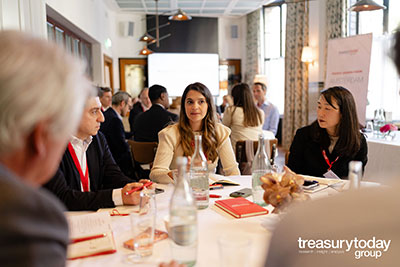
After the panel discussion, Jackson introduced a group exercise focusing on best practice and innovation. Attendees were invited to share how best practice is evolving in their own teams and organisations.
Marco Schuchmann, Director Treasury at Bruker highlighted that treasury spans numerous types of risk – and while in the past it was a challenge to consolidate the relevant data in a timely and accurate way, there are now many tools available to provide reliable data at a fingertip. This allows more time to be spent on risk mitigation than just getting correct data.
“I’m currently looking at inventory management, and how we can do inventory financing for the company, which has led to a much wider discussion within the organisation, whereby Treasury initiated the discussion on structural working capital improvements,” he said.
“In treasury, we have the possibility of applying payment infrastructures or financing systems that increase sales, ie accepting credit card payments or securitisation of receivables to free-up credit limits or the supply of advance payment guarantees to ensure customers their investment is secure. And these are things we can do because we are a business partner.”
AI adoption in practice
Building on the previous discussion, several attendees focused on AI, and the importance of having clean, reliable data in place before adopting AI tools. “We had a discussion about whether treasury should really own the data, or whether it should be internal IT,” said Michel Verholen, Assistant Treasurer – Global Treasury Operations Lead at Zoetis. “In either case, whoever maintains the data needs to have a close relationship to the business, and really understand the driver behind all the different processes.”
Dave van der Zwan, Head of Treasury at CM.com observed that having multiple teams working on AI projects in isolation is not effective – “so as a company, we have three full-time equivalents running internal AI. They work across the groups and serve as a support function to the business functions to accelerate sustainable AI adoption.”
Dorian Mazzilli, Treasury Manager at Airwallex, said the company built its treasury management system in-house and is now incorporating AI to generate deeper insights. “For example, we can analyse USD rate conditions across our banking partners and identify where returns are less competitive. We are also exploring AI to support more intelligent money movement, helping us concentrate cash with the banks and money market funds that offer the best conditions.”
And Kidus Yared, Country Head of Global Payments Solutions, The Netherlands at HSBC, highlighted the importance of protecting sensitive data and using it in a diligent and safe way. “We have lots of different use cases within our organisation – it’s about understanding those risks and making sure they are really being looked at,” he added.
Growth, community and leadership
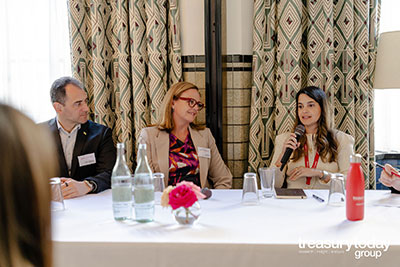
The second panel discussion of the day focused on growth, community and leadership in times of uncertainty. Jackson was joined by Ana de Sousa, Global Treasurer, Senior Director at global payroll and employment infrastructure company Remote; Cara Savas, European Regional Head of Sales at HSBC Continental Europe, and Feliks Indenbaum, Head of Group Treasury, Jetbrains N.V.
De Sousa said she started off by working as a banking supervisor at Banco de Portugal, before moving to Switzerland and beginning her career in treasury. She subsequently joined Remote to build the company’s treasury team. “We implemented our treasury management system, Kyriba, and since then we have had automation as part of everything we do,” she noted.
Indenbaum discussed his career path and his current role at Jetbrains. He reflected that industry events like the Finance Leaders Forum provide an important opportunity to gain insights from peers and implement new ideas in his day-to-day role.
Speaking with authenticity
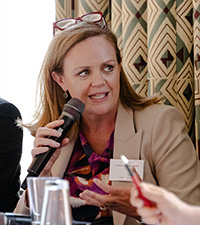
Jackson asked Savas for her views on how to speak publicly with authenticity. “It’s a lot of work not to be yourself, and to put on a mask,” Savas reflected.
“That’s not to say we shouldn’t have a more professional version of ourselves, and then a more relaxed version in private. But I think if you’re genuinely passionate about what you do, and you’re honest in your dealings with your colleagues and clients, then you’ll know those relationships are there.
“So for me, it’s about not putting on a mask – really believe in what you’re doing, and then when you do, it’s not really a performance.”
Innovation and psychological safety
Returning to the topic of AI, Jackson asked the panel how their teams were responding to this change.
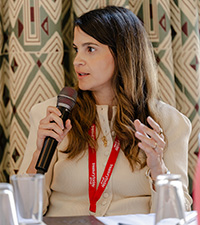
De Sousa said that Remote began implementing AI in its product in 2024, “And in finance we are exposed to this, but not directly – I don’t want to pretend I have a team of engineers completely focused on this for treasury.”
She added that before investing in AI, it had been important to build a robust foundation by implementing the TMS effectively and focusing on efficiency and automation. “But recently I’m seeing tasks being replaced, particularly through agents,” she said, noting that the company is already seeing significant changes in areas such as bank account opening.
Reflecting on the importance of psychological safety, Savas said “the one thing I think we have to look for, and encourage consistently, is curiosity. Because when you’re afraid of the technology, that can have a very negative impact on how you’d be willing to use it.”
Embracing visibility
Jackson pointed out that workshops and other events present an opportunity to build a community and share ideas. “If there’s anyone you’ve connected with today, I’d really encourage you to keep in touch with each other and build those safe relationships where you can be honest about challenges you’re facing, but also some of the wins on that journey,” she said.
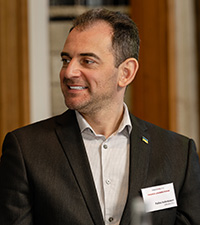
Indenbaum, likewise, highlighted the importance of exploring new opportunities, discussing industry challenges, and sharing stories and experiences with others in the community.
Savas added, “When you get into sharing your knowledge more publicly, the first time you do it is the hardest. But I do think it’s very important for your teams, your bosses and your talent to see that you know what’s possible, and to make people more comfortable with that.
“AI will be a great leveller in terms of content – maybe in expertise – but the relationships you have and the representation of your company or your team is really key.”
Leadership and wellbeing in challenging times
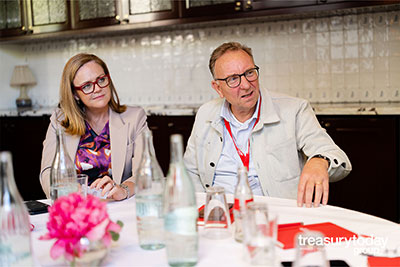
In the final exercise of the day, Jackson invited attendees to discuss their experiences of managing and leading in the current environment, while looking after themselves and their teams.
Empowerment and keeping calm
Empowerment and trust were recurring themes. Cansu Sugün, Senior Treasury Manager at Meltwater, said she feels “trusted and free” in her current role, noting that the company provides flexible time off and flexible working, “which has really encouraged people to stay in the company.”
Marcel Onclin, Head of Treasury and Insurance at Flora Food Group shared his experiences working for a private equity portfolio company, noting that “in the beginning, when you disentangle from the mothership, the routines and process that were normal are gone instantly. And that makes people very nervous.”
To overcome this, he says it is essential for leadership to stay calm, while respecting people and their boundaries. “I’ve seen it go wrong. Usually because during a spin-off, the mother company provides opportunities for new managers to step up their role and start leading teams,” he added. “So the people joining the parting company may end up in a situation when where they have to start showing leadership under strong pressure, this is not always easy.”
Managing wellbeing and knowing your worth
The forum concluded with the attendees discussing how they manage their own wellbeing.
Finally, Jackson asked attendees to reflect on communicating their worth and preparing an ‘elevator pitch’ to explain the value they’ve brought to the business. “I’m doing away with the term ‘soft skills’ – they should really be called ‘essential skills’,” she concluded. “And with the advent of AI, these are the most important skills you’re ever going to have.”