Best Foreign Exchange Solution Winner: Ingredion Incorporated
Published: Jan 2015
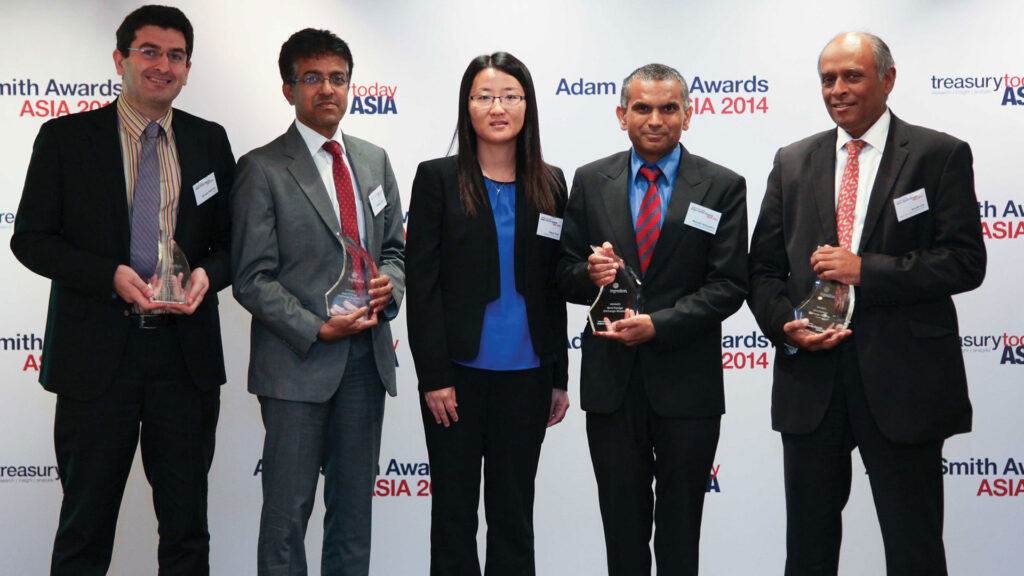
Photo of Mahesh Srivastava and Hui (Helen) Chen, Ingredion Incorporated, Ramesh Swamy of J.P. Morgan, Sunder Iyer of Bank of America Merrill Lynch and Nicolas Adjemian of Reval.
Mahesh Srivastava
Assistant Treasurer – International
Ingredion Inc. is a leading global ingredient solutions provider to the food, beverage, brewing and pharmaceutical industries as well as numerous industrial sectors. Headquartered in Illinois and employing more than 11,000 people, the company serves customers in more than 60 diverse markets in over 100 countries.
in partnership with
Consolidating global currency and risk management processes in Asia Pacific
When Ingredion acquired National Starch, it went from being an international company to a global company, with all the complexities that came with it. Their plan was to consolidate all the global currency and risk management processes in Asia Pacific and then look at the people they needed to run these systems – rather than looking at the people first and the system second. They wanted to integrate a single bank platform and a single currency platform and link them both for optimum treasury technology in the region.
The challenge:
“We ended up with a geographical footprint covering many countries in Asia, including Australia, New Zealand, Thailand, Vietnam, Singapore, China, South Korea, Japan, Philippines, Indonesia and Malaysia. All of these countries had their own banking systems and were very disparate,” explains Mahesh Srivastava, Assistant Treasurer – International at Ingredion. Of course, with an international footprint comes increased foreign exchange exposure.
The treasury team had two choices; to put in place a centralised regional treasury in Singapore or to implement a systems-based solution.
The solution:
Srivastava chose the latter approach: “our plan was to consolidate all the global currency and risk management processes in Asia Pacific and then look at the people we needed to run these systems – rather than looking at the people first and the system second. We wanted to integrate a single bank platform and a single currency platform and link them both for optimum treasury technology in the region.”
Ingredion implemented a well-known multi-bank currency trading platform as well as leasing Reval’s currency risk management system and Misys for settlement and confirmation. The systems were integrated to provide a streamlined process. “If someone did a deal in Indonesia, it meant that one system fed into Reval, so there was no manual intervention after the deal was done,” says Srivastava. “Reval did all the ‘mark-to-market’ and accounting generated the dual entries and confirmation was provided via the link between Reval and a confirmation matching service provider.”
Best practice and innovation:
The company’s decision to integrate one of the chosen systems using a global, decentralised model is particularly unusual. “Instead of saying that we wanted to have people in the US or a dedicated treasury centre managing this, we said we would manage the project internationally while providing the local teams with the necessary tools and undertaking the control work ourselves,” says Srivastava. “For example, we have Indonesia managing their balance sheet exposure, but we’ve trained them how to do it and we are monitoring it from a control basis. Reval has told us that we were the first people to integrate this type of infrastructure across a global spectrum.” Also, we were able to centralise through technology and provide cross-border back up. As an example, if someone from Thailand is on holiday the trade for Thailand can be initiated in Korea, approved electronically in the US, traded in Korea and then confirmed automatically. We call this concept ‘centralisation through technology’.
“Our plan was to consolidate all the global currency and risk management processes in Asia Pacific and then look at the people we needed to run these systems – rather than looking at the people first and the system second.”
Key benefits:
Enhanced simplicity with single bank platform and single currency platform.
No manual intervention post-deal.
Better exchange rates.
Further scope for implementation in other countries.
Automated Accounting.
Significant reduction in time and enhanced efficiency.
Transparency of global pricing.
Cross border and corporate visibility.
The Adam Smith Awards Asia is the industry benchmark for best practice and innovation in corporate treasury. To find out more please visit treasurytoday.com/adam-smith-awards-asia