On 11th September, Treasury Today Group welcomed its Women in Treasury & Finance community back to London for the annual EMEA Forum.
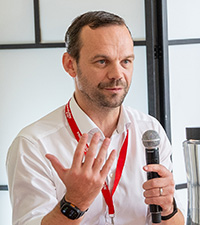
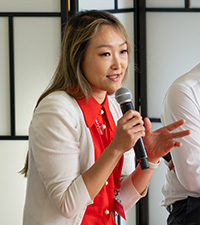
The day began with an intimate workshop with Deutsche Bank exploring the power of strategic negotiation. The two-hour session included a fireside chat with Johnny Grimes, Head of Corporate Cash Product and Head of Corporate Bank Ireland at Deutsche Bank and Eva Yang, Global Treasury Consultancy at GSK.
Eva explained that “preparation is a huge part of any negotiation. Understanding what you want to get out of something in advance, and taking the time to do it, is a critical part of being successful.” She also highlighted the importance of coaching: “It’s not just about giving opportunities and putting people into difficult challenges that stretch them. You have to find room for them to get the toolkits to be successful as well.”
This was followed by an interactive hour-long session led by executive coach, Joana Matos, Deal Expert at the Office for Negotiation at Deutsche Bank. Joana explored practical skills for negotiating with greater confidence including stating what you want, building rapport, asking powerful questions, controlling your body language and navigating pushback.
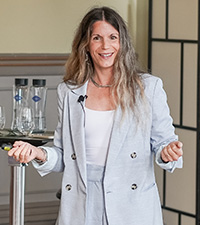
“Women negotiate much better on behalf of other people,” she noted. “So whenever you feel uncomfortable to negotiate for yourself because you feel selfish, remember you’re not doing it for you. You’re doing it for me, you’re doing it for our daughters, you’re doing it for everyone that is coming. We need to create a new reality where it’s OK and comfortable for women to ask for what they want.”
Treasury Today Group’s Angela Berry then shared her experiences of forging a career in financial publishing after leaving school at 15. She subsequently founded Treasury Today Group in the 1990s, juggling motherhood with the demands of a fledgling business.
“In my opinion, to found and build a successful business, you’ve got to have focus, you’ve got to be fearless, you’ve got to be brave, you’ve got to be inspired,” she said.
“For a female-founded and female-led business, Women in Treasury & Finance was a natural evolution for us, and I’m immensely proud that we were the first to launch such a platform over 15 years ago.”
Asking for help
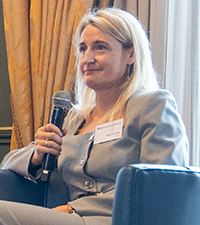
The main forum began with a welcome reception and fireside chat with Sophie Jackson, CEO of the Treasury Today Group, and Gemma Lewis, Europe Head of Client Service – Global Payments Solutions (GPS) at HSBC.
Sophie and Gemma discussed the power of authenticity and vulnerability. “I think it’s important that people see you are a human being,” said Gemma. “There’s nothing wrong in admitting when you need help or that you’re going through something, whether it’s personally or from a work perspective.”
Sophie asked about the pressures experienced by people in midlife who may have young children, as well as parents who are getting older.
“One thing that I really struggle with at times is, what do I do first?” said Gemma. “What can I take off the to-do list? I want to be a good mum – but my parents need my help as well.” Her advice was “never think you can’t do it” – instead, draw upon your community and be strong enough to ask for help.
Reflections on the Global Equity Study
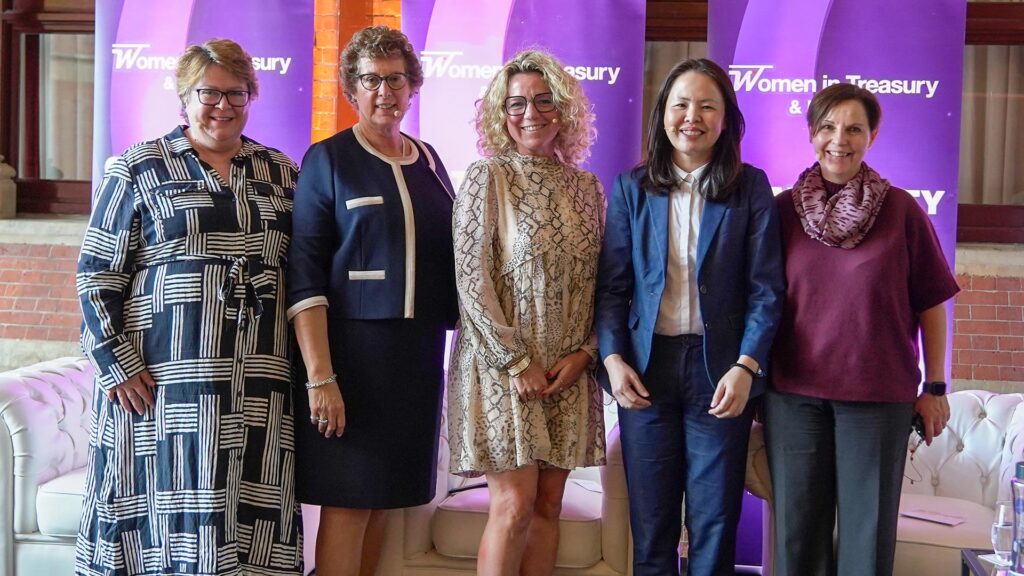
Following the presentation of the 2026 Women in Treasury & Finance Awards, Treasury Today Group’s Special Correspondent Liz Lumley welcomed attendees to this year’s panel discussion.
The discussion began with the panellists’ reflections on Treasury Today Group’s Global Equity Study 2026, supported by Standard Chartered. This year’s study explored topics including equal pay, board quotas, mental health and male allyship.
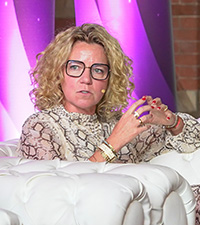
Veronique Steiner, Head of Innovation Economy, EMEA, J.P. Morgan Payments, highlighted the study’s finding that 78% of respondents agree that gender diversity drives better performance. “People recognise that diversity is essential to building stronger, more effective teams through collective thinking and perspectives,” she observed.
In addition, 81% of respondents said that mentoring/sponsorship is key to a successful career. “You need to make sure that mentoring is intentional,” said Veronique. “It’s not through luck that you’re able to see somebody – it really needs to be driven and organised by companies.”
Margaret Harwood-Jones, Chief Executive Officer, Europe and UK, Standard Chartered, noted that just under 60% of male colleagues had said their organisations provided the tools and support they needed to engage in DEI initiatives – “but then the other data suggests that the level of awareness and participation was not great. For me there’s a disconnect there – resources are available, but people are not using them.”
Turning to the findings about flexible work, Michelle Ang, Chief Financial Officer, Daimler Truck Financial Services Group, Global Finance Execution & Advisory, Daimler Truck AG, noted that these types of arrangements create valuable opportunities for many employees, particularly working parents or those balancing professional and caregiving responsibilities. “But many employers are increasingly focussing on in-person collaboration.”
Her experience shows that approaches to office attendance can vary significantly between companies and markets. In the Americas, says Michelle, “return-to-office mandates tend to be strictly enforced, often tying compliance directly to performance. In Europe, the focus is often on voluntary returns via positive reinforcement; and the Asian approach is centred on collaboration, culture and connection.”
Imposter syndrome and non-linear careers
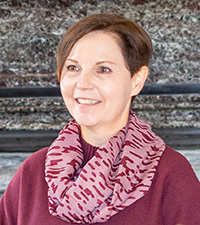
Next, Liz asked the panellists about their backgrounds and career history. Carol Thurnheer, Senior Manager International Treasury, Haleon plc – who was named Woman of the Year EMEA in this year’s Women in Treasury & Finance Awards – spoke about her challenging upbringing, and how this had resulted in a non-linear career.
“University was never on the cards for me,” she explained. “When you apply for a role, what do you put on the application form if you haven’t been to university? You’re sorted out immediately. So I did all of my qualifications in the evening while working full-time, which built resilience and a desire to grow and do different things.”
While working for a US corporate in Switzerland, Carol was offered the chance to move to Luxembourg for two years. “I didn’t really feel ready, but I also had that desire to do more with my life than just be in one country,” she said.
Reporting into the group treasurer, Carol progressed through a number of different roles and eventually landed in treasury herself. During the pandemic she decided to do her MCT qualification, in a cohort that mostly included CFOs and group treasurers. Despite struggling with imposter syndrome, her success in passing the qualification when many others failed made her feel she had earned a “place in that room.”
Picking up on the theme of non-linear careers, Margaret related to a time when she applied for a different role, which was then given to another candidate. “What I hadn’t realised was that when a new leader comes into your midst, what a wealth of new experience is given to you! I learnt so much from that lady, and when the next opportunity came, I was much more prepared for that elevated role and responsibility.”
Maternity and motherhood
Veronique spoke about her three different experiences of returning from maternity leave – one straightforward, one positive and one highly challenging. Like Margaret, she reflected that her experience of adversity made her a lot more resilient, and had made her determined to ensure that others did not have the same experience.
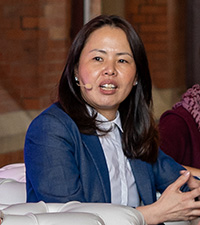
Addressing the challenge of balancing career demands with ‘mum guilt’, Michelle emphasised that women should feel empowered to establish firm boundaries around their evening schedules. Referencing former President Barack Obama’s commitment to family dinners, she reiterated that no matter how demanding a role may be, leaders can and should safeguard personal well-being and family priorities.
Margaret added: “The one thing I would really emphasise: none of us are super mums. How many days have we lived through where we think, ‘I’m not getting it right at work and I’m not getting it right at home’ – frankly, that’s the reality.”
What helps, she added, is being well organised, embracing structure and discipline, and being adaptable. “And yes, sometimes you do just feel you’re working through it day by day.”
Hitting the ground running
Responding to a question from the audience, the panellists shared their advice for newly appointed managers.
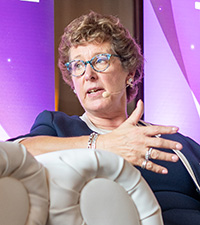
“Number one, recognise that it’s a different role,” Margaret advised. “When you’re new in a role, do a lot of active listening – both to the team that you’re working with, your leaders, the broader stakeholder community and sometimes your clients as well.”
She added that in any new role, “you’re not going to get it all right on day one. In any new role, you have a certain number of phases or iterations in that role.”
Veronique highlighted the importance of finding mentors. “Mentoring can come from somebody more senior, but reverse mentoring matters too.” She explained that junior team members often provide particularly valuable on-the-ground knowledge of emerging tools and customers’ evolving needs.
Strengthening your strategic narrative
Turning to the evolution of treasury, Michelle spoke about her recent transition into a CFO role, while still heading an international treasury organisation.
“The transition that I’ve seen over the years is that organisations start to get flatter,” she noted. “In my organisation, we are delayering our organisational structure to eliminate approval bottlenecks and foster faster and more agile workflows.”
She added that there are valuable insights that can be harnessed from the finance and treasury functions. “To successfully monetise these insights, finance and treasury teams must pivot from gatekeepers to strategic partners who deliver actionable business value.”
Treasurers inherently have a macro view of global market dynamics, she said. “Their greatest value lies in the ability to translate complex macroeconomic trends into practical business drivers.”
“Strengthening your storytelling becomes more important than ever to be able to bring your expertise to the table and drive decisive business action.”