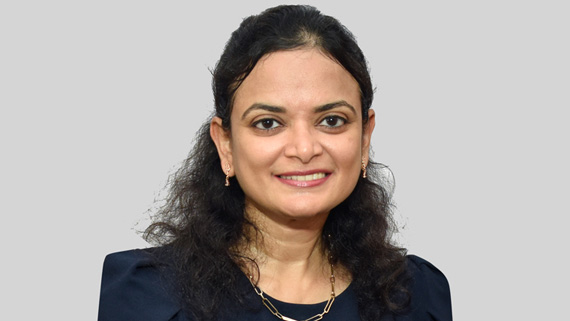
According to Annapoorna Group Chief Financial Officer at Jio Financial Services, her work profile changed every few years.
“Whether it was lending, special projects, financial markets, international corridors, digitalisation, enterprise risk management, insurance or planning,” she added. “I have benefited immensely from these diverse roles and wholly believe in pay-forward.”
Despite a long career in the banking sector, Annapoorna moved to the manufacturing industry in January 2024 at ArcelorMittal/NS India, where she was soon promoted to Chief Treasury, Risk, Insurance & Capex Investments. There she was instrumental in overseeing the company’s capital expenditure programme and strengthening its financial infrastructure during a period of expansion.
During her tenure, Annapoorna delivered a series of initiatives aimed at transforming the treasury operations. These included structuring a large-scale domestic project finance facility with Indian banks and leading a complex treasury digital transformation across 17 operating entities. The transformation modernised cash management, bank reconciliation, cross-border trade and FX operations through an integrated suite of APIs, RPA and AI-enabled workflows within SAP S/4HANA – significantly enhancing efficiency and control.
That transition from the financial world to “an asset-heavy manufacturing setup” was a strategic pivot that helped broaden Annapoorna’s exposure to a sector she admits “operates very differently”.
Annapoorna wishes the banking world better understood the “sheer size and scale of the ecosystem that manufacturing firms have”. That means that firms need real-time visibility across the value chain – from raw materials and finished goods to cash – “in order to sweat working capital optimally”.
However, core principles from banking have worked in manufacturing such as making processes more efficient, she said.
“At one point, we took a hard look at all our current processes and sat down to debate why each process should be continued with,” said Annapoorna. “Only those processes that were found to be fit-for-purpose were carried forward, while others were tweaked as necessary.”
Beyond her corporate achievements, Annapoorna is a committed advocate for diversity and inclusion.
Diversity is “incredibly important, and honestly, it’s just good business,” she said. “When you’re dealing with multi-billion-dollar investment plans under volatile external environments, having a diverse leadership team gives you much sharper controllership and far better corporate governance.”
Ultimately, workplace meritocracy should be regardless of gender, she added. For example, what “matters” at a “beginner’s level”, is a positive attitude, she said.
Diversity of expertise and knowledge in a team is equally important. At Jio Financial Services, Annapoorna’s team is pooling resources from different verticals like financial reporting, taxation, and business performance monitoring to channel individual knowledge into collective intelligence, she said.
“There are no right or wrong attributes, and every one of these attributes is important in a boardroom for critical thinking,” she said. “You can’t magically have a diverse C-suite if you don’t build a diverse foundation first. A lot of companies try to fix diversity by only hiring laterally at the very top, which is when culture and collaboration issues creep in.”
Today, agile banks need to deliver timely, smart, out-of-the-box digital solutions, while staying within regulatory and risk guardrails, said Annapoorna. When Annapoorna started her career, digital transformation was mostly about automating paperwork. However, today, it’s about creating what she calls “touchless treasury”, which is an ecosystem that practically runs itself with human-in-the-loop.
“During my banking days, we implemented an industry-first, fully digital platform spanning FX hedging to cross-border trade settlement,” she said. “We used host-to-host protocols to connect corporate ERPs with banks.”
Later, within manufacturing, APIs were implemented for real-time cash and FX visibility, executed bulk payment files, data lakes for management dashboards, and bots for bank reconciliation, she said. This led to an increase in automated treasury transactions from 25% to over 90% in around 18 months, reducing bulk payment execution time from four hours to under 20 minutes. “This freed up bandwidth for more value-added liquidity creation,” she added.
Annapoorna’s advice on what leaders need to consider while driving enterprise-wide digital transformation, includes fixing the process before the technology.
“Digitising a broken process just gives you a faster, broken process. Map out your standard operating procedures perfectly before you start building,” she said.
It also includes looking at every legacy process and asking, “Is this actually fit for purpose?” “If it’s redundant, cut it; keep things lean and nimble,” she added, and “trim the fat.”
For today’s treasury teams, reactively tracking cash and preparing static yield MIS is passé, she said. Now it is about diving into deep AI integration.
The idea of an “atomic treasury”, of instant, 24/7 liquidity management and immediate settlement, “has become a baseline requirement”, said Annapoorna.
At Jio Financial Services a new-aged treasury is being developed without any legacy systems. “When all automated workflows emanate from and re-wire back to your ERP and data lake, we expect the Agents to enrich the data, act timely with precision, drastically improving treasury outcomes,” said Annapoorna.