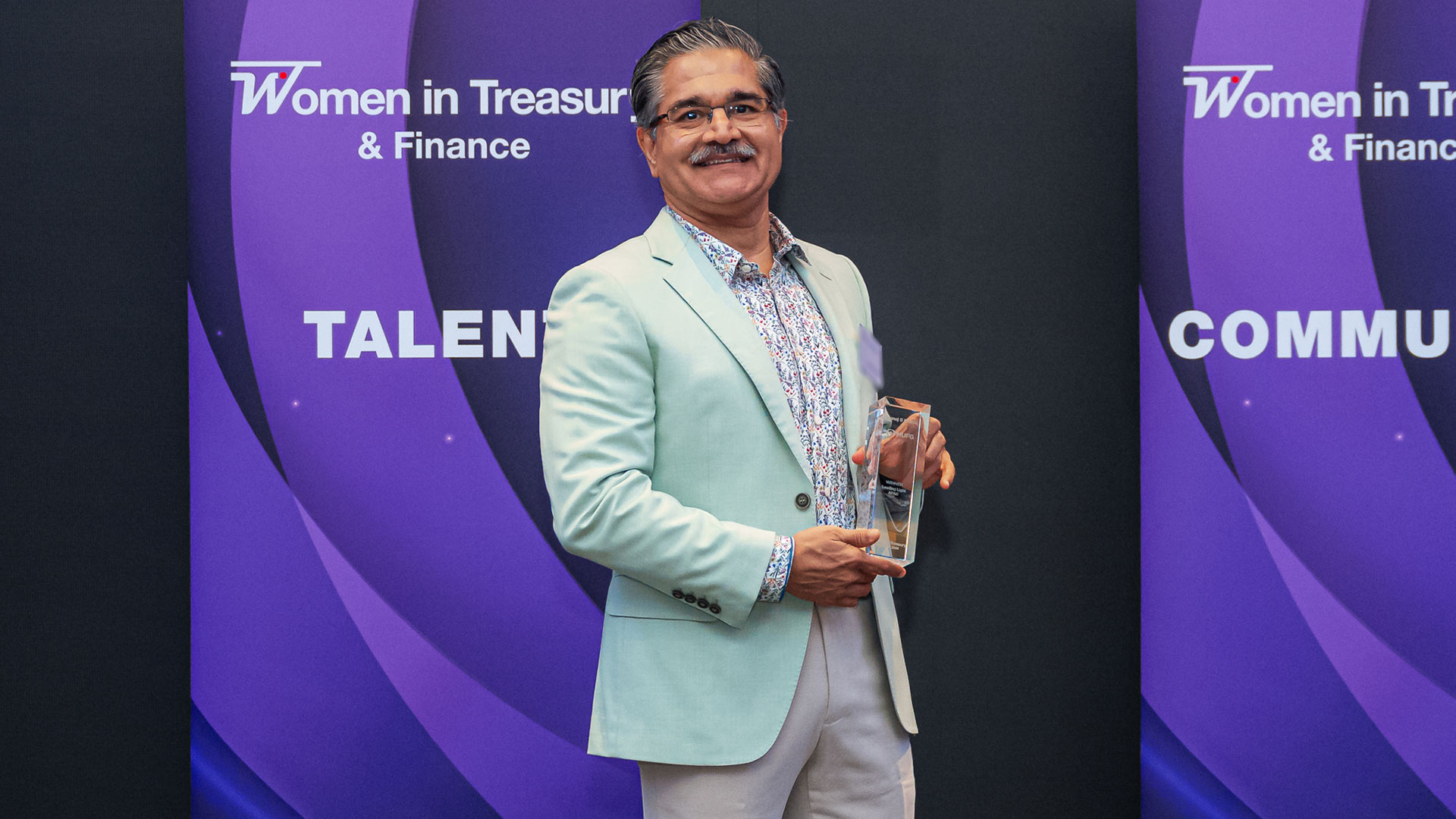
Receiving Treasury Today Group’s Women in Treasury & Finance Awards – Leading Light Award, Manoj S Bhatia of MUFG sees the accolade as a “call to action”.
“All of us need to be feminists” says Bhatia, on addressing the issues around achieving gender parity and diversity in leadership roles in the wider financial services sector.
Pointing to the reality that 50% of the population are not well represented in institutions and leadership roles, “men need to play a much bigger role than what they play today,” says Bhatia. “If there is anyone who can champion this agenda for gender diversity, it is honestly the men who need to be leading.”
After a career spanning over 30 years including senior roles in transaction banking at Citi and now at MUFG, Bhatia adheres to a few guiding principles for leadership; the most important being: “as a leader, you want to groom more leaders”.
Those leading teams and departments need to be “fair enough to guide” while being “close enough to be relatable”. Escalations or negative news should be seen as an opportunity to understand when a project or a strategy isn’t working,” he says. Institutions should not be run with a “king culture, where people work in line with what they think their boss wants.”
“People really need to feel comfortable; they need to see the warmth, they need to feel welcome to approach you,” he adds. “I think my job as a leader now is to ensure that people walking in through the doors of these offices are feeling good about who they are, … really feel welcome and feel good about coming to work, because they will get their best only if they’re feeling their best.”
As Global Head of Subsidiary Banking and the GSB Head of APAC, Bhatia is a member of the Global Corporate and Investment Banking (GCIB) Executive Committee for Asia Pacific and reports globally to the GCIB CEO’s office in Tokyo. When he joined in 2018, GCIB accounted for 7% of MUFG’s global net profits. Today, they account for 33% of the bank’s net profits. Because of that, the operations of the GCIB have greater visibility within the institution and the ability to influence the adoption of global best practices, including some that may be deemed new or different from the vantage point of a Japanese organisation.
Under the leadership of the global head of GCIB, Fumitaka Nakahama, the bank launched “Bright Futures”: a global programme focused on empowering women.
“We have the challenge in most organisations, and that’s true for banks, and it’s true in a Japanese bank, is that the minute you are hitting director/MD level the population mix changes very quickly,” said Bhatia. “There are very few women at very senior levels within the firm, and the objective of this programme is to actually fix that.”
The programme takes women who have reached vice president or director level at the bank and offers them a structured programme that offers skill development and experiences in the bank’s global offices around Asia, the Americas and EMEA. The programme is also extended to male colleagues, both as participants and mentors, in recognition of inclusion and equal opportunities. The goal is that after a year, the skills gained will enable participants to advance to a more senior level at the bank.
In addition to international experience, participants receive one-on-one coaching and access to senior forums and board-level meetings.
“The biggest challenge we hear about is on visibility,” says Bhatia. “Give us that visibility, make us much more visible in the organisation, so people can really recognise what we can bring, and that’s what we try to do in a very structured manner.”
So far, around 126 people have graduated through Bright Futures, with 16% achieving promotions to the next level of seniority.
“We’re advocating the equal opportunity agenda,” he says. “By putting into practice and recognising what we think is right.”
Leading on what “is right”, Bhatia was conferred a “Leading Light” at Treasury Today’s Women in Treasury & Finance Awards. He says he is “deeply humbled and incredibly honoured” to receive this recognition, and it is a privilege he “does not take for granted”. However, he is quick to correct that an award like this is not a title, but “an action”.
“All of us have core values, and this recognition serves as a strong reminder that I need to further embed equal opportunity as one of my core values and ensure that I’m actually living it on a daily basis,” says Bhatia. For him, issues around gender parity, diversity, equity and inclusion extend beyond workplace challenges; they encompass human dignity.
“When you see the ongoing discussions today, embracing our authentic selves actually requires people to be brave,” he says. “Progress cannot solely rest on the shoulders of the underrepresented, but a responsibility shared by all of us.”