
Home

Best Cash Management Solution Highly Commended: adidas Group

Published: Jan 2015
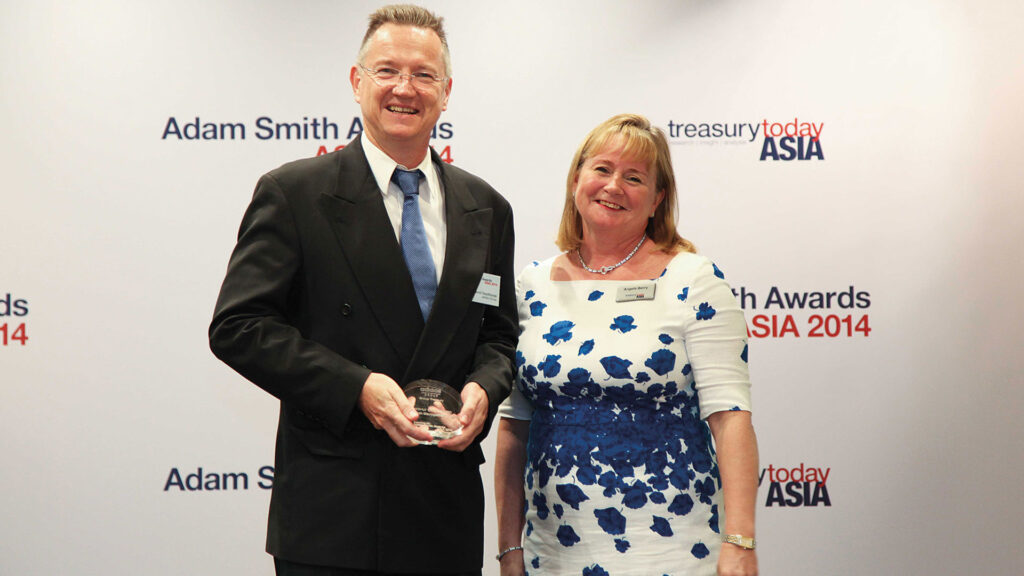
Photo of David Gaythorpe, adidas Group.

Photo of David Gaythorpe, adidas Group.

Damjan Stukelj

Director Treasury Global Financial Operations
adidas Group logo

adidas AG is a German multinational corporation that designs and manufactures sports shoes, clothing and accessories. Employing more than 50,700 people in over 160 countries, it produced more than 650 million product units and generated sales of €14.5 billion in 2013.

Simplifying to the max: a global centralised cash management structure

adidas suffered from a lack of transparency and an inefficient cash disposition managed by multiple people in Hong Kong and China. The company’s account structures were complex with multiple bank-specific payment and information channels and e-banking systems. The company aimed for an integrated solution within its ERP environment, with SAP being the key IT application running within the Finance function. The integrated solution allows full transparency of all transactions in the ERP systems and is audit-proofed.

The challenge:

adidas suffered from a lack of transparency and an inefficient cash disposition managed by multiple people in Hong Kong and China. The company’s account structures were complex with multiple bank-specific payment and information channels/e-banking systems. It also had multiple payment formats and payment processes and there was no standard bank statement processing or bank documentation. As a result there was no consistent, automated and standardised short-term cash forecast.

Further complicating these challenges, adidas faced time zone difficulties between Europe and Asia as the rollout of any new project would need to be driven out of the Group Treasury headquartered in Germany.

The solution:

The company aimed for an integrated solution within its ERP environment, with SAP being the key IT application running within the Finance function. The integrated solution allows full transparency of all transactions in the ERP systems and is audit-proofed.

The solution comprises several key features:

  • A global, standardised payment process using the majority of current ISO XML payment files 20022 V3. Payment files are delivered via the Bank Communication Manager (BCM) module and not via e-banking platforms to four global cash management and payment banks as a host-to-host solution.

  • This is standardised in a unique payment process for trade financing payments, commercial payments, manual payments and HR payments.

  • The integration of harmonised payment processes in two different ERP systems.

  • The automation of cash forecast information based on the Cash Management (CM) module in two different ERP systems for HKD, CNY, EUR and USD.

  • The automated daily USD concentration for three entities through cash pooling, including third-party pooling. The USD position is concentrated daily via the ‘follow-the-sun’ principle at a header account in New York and managed out of the Group Treasury HQ in Europe.

  • The automated daily cash concentration for five entities for HKD to a non-resident account in Hong Kong managed out of HQ Group Treasury located in Europe.

  • The automated daily cash concentration for five entities for CNY to a local account of their entities in China.

  • The automation of bank statement processing.

  • Global, harmonised and standardised bank documentation for new and migrated accounts including global e-banking administration.

“We built internal expertise to support daily activities at HQ level. In this way the rollout can be managed centrally and globally and leads to the independence of external support,” explains Damjan Stukelj, Director Treasury Global Financial Operations at adidas.

Best practice and innovation:

The solution has led to the creation of a global centralised cash management structure to address these challenges.

The new applications have been rolled out within a highly complex IT landscape, for ten entities, with four global cash management banks. The solution is valid for two different ERP systems and various sub-systems.

The CM and BCM modules are set up as follows:

  • CM:

    All relevant cash forecast data is transferred between the different ERP systems, so called distributed cash management.

  • BCM:

    All payment information is transferred between the different ERP systems, so called BCM connector solution.

“All these activities reflect our motto ‘simplify to the max’,” says Stukelj. “We can be proud of what we have achieved and have the full support of top management to continue our rollout journey globally. At the moment we are approaching Australia, New Zealand and Japan with the same objectives and targeting the first half of 2015.”

As a testament to the success of the solution, the company has been approached by some of its peers for benchmarking purposes.

Key benefits:

  • Standardisation and optimisation.

  • Automation.

  • Greater visibility and control.

  • Time savings.

  • Integration.

The Adam Smith Awards Asia is the industry benchmark for best practice and innovation in corporate treasury. To find out more please visit treasurytoday.com/adam-smith-awards-asia

All our content is free, just register below

Already have an account? Sign In

Already a member? Sign In