
First Class Relationship Management Winner: Bharti Airtel
Published: Jan 2016
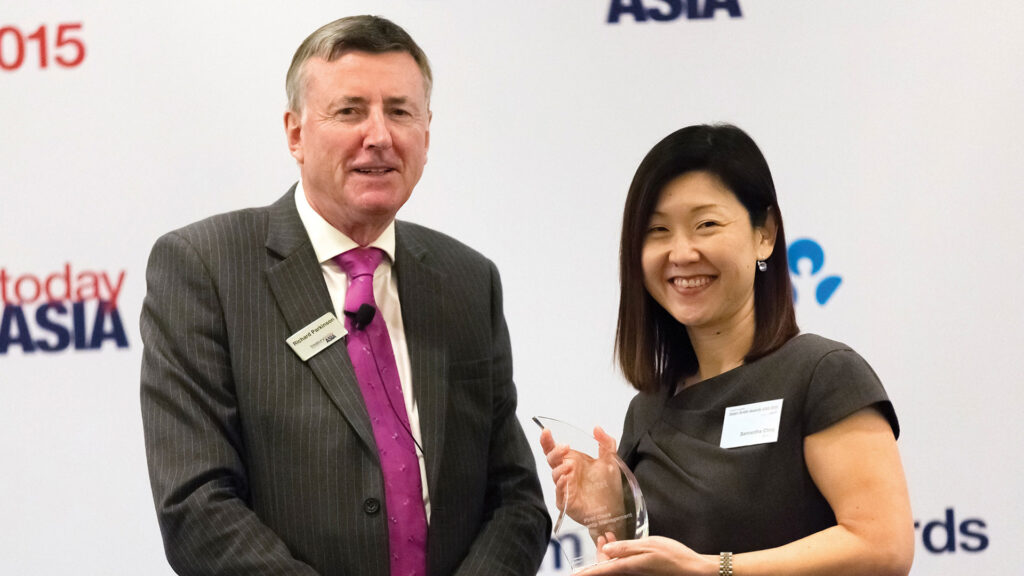
Photo of Samantha Chng representing Bharti Airtel.
Harjeet Kohli
Group Head, Group Funding, Risk & Markets (GFRM) & Investors
Bharti Airtel Limited is a leading global telecommunications company with undertakings in 20 countries across Asia and Africa. Headquartered in New Delhi, India, it claimed approximately 340m customers across its operations at the end of September 2015.
Internal and external stakeholder management the Airtel way
Managing its relationships across the capital structure is core to the philosophy of Airtel; it considers its financial stakeholders as deeply entrenched partners in the business. Effective handling of this resource is critical and comes with its many complexities. Read how Kohli went about this stakeholder management exercise.
The challenge:
Managing its relationships across the capital structure is core to the philosophy of Airtel; it considers its financial stakeholders as deeply entrenched partners in the business. Effective handling of this resource is critical and comes with its many complexities. As Harjeet Kohli, Group Head, Group Funding, Risk & Markets (GFRM) & Investors explains: “the need and scope of such an exercise of stakeholder management is essential not just to the finance function but also to the company as a whole”.
The solution:
Treasury secured a permanent slot at each board meeting of Airtel, presenting the issues, challenges and solutions.
The roles of Group Treasurer and Chief Investor Relations Officer were combined, leading to the creation of a unified communications exercise. Execution focused on the following aspects:
Communicating the status, opportunity, strategy and execution plan with all constituents.
Driving and executing all key strategic priorities, maintaining credibility among key stakeholders, from the board to external equity investors.
The company anticipated deleveraging across global banks to be a major requirement; Kohli worked with his sponsors and board to secure the approvals to undertake global bond issuances. This involved close interaction with the ratings agencies, which ultimately saw the firm gaining full Investment Grade rating from all three.
Airtel created a holistic fixed income ‘investor engagement’ roadmap:
A separate website was created for investors, providing a regularly updated view of the company’s financials and results.
Despite no immediate need, the company also looks towards alternate currency liquidity pools to build a strong potential new debt investor pool.
Airtel aligned its resource allocation to focus on a mix of new and existing investors to ensure diversification and strength: 40% of its time is dedicated to engaging new investors, 40% to existing investors and 20% on research.
To cultivate more partnerships and effective solutions, RFPs were opened across India and Africa.
Index providers, such as MSCI, were consulted. Over time it fulfilled the twin objectives of removing the haircut on weightage placed on Airtel stock, and the securing of Infratel’s inclusion in the MSCI index.
Focus on both stocks further strengthened the new FII investor-base (increasing FII holdings from 18% to 24% in Bharti Infratel equity, and 16% to 19% in Bharti Airtel equity over the previous 18 months) and also realised secondary market liquidity and better price discovery. within two and a half years of listing.
In less than three years, Infratel has become a top 25 listed company in India by market capitalisation.
Best practice and innovation:
All stakeholder interfaces have been strengthened, including the boards of the two companies, investors in both equity and debt markets, and the rating agencies, lenders and multilateral agencies.
Airtel has seen stronger numbers and tangible results of all the above, evident in market reception, improved ratings, higher credit appetite, higher FII holdings, plus a whole new investor class in debt markets with the addition of over 400 new investors.
“There is no over-dependence on any particular class of credit provider and, as a result, we have a very healthy currency mix and a balanced fixed-floating rate mix of debt, as well as average maturities in excess of five years,” notes Kohli. “This is surely a worthy feat for a fast growing EM telecom operator.”
Key benefits:
Stakeholder engagement greatly improved.
All internal and external interfaces strengthened.
Direct feedback on its capital structure aiding treasury planning, demand/supply for issuances, right understanding of spreads, benchmarks, appreciation of credit, thereby aiding the treasury planning immensely.
Treasury enabling and feeding business strategy and vice versa.
The Adam Smith Awards Asia is the industry benchmark for best practice and innovation in corporate treasury. To find out more please visit treasurytoday.com/adam-smith-awards-asia