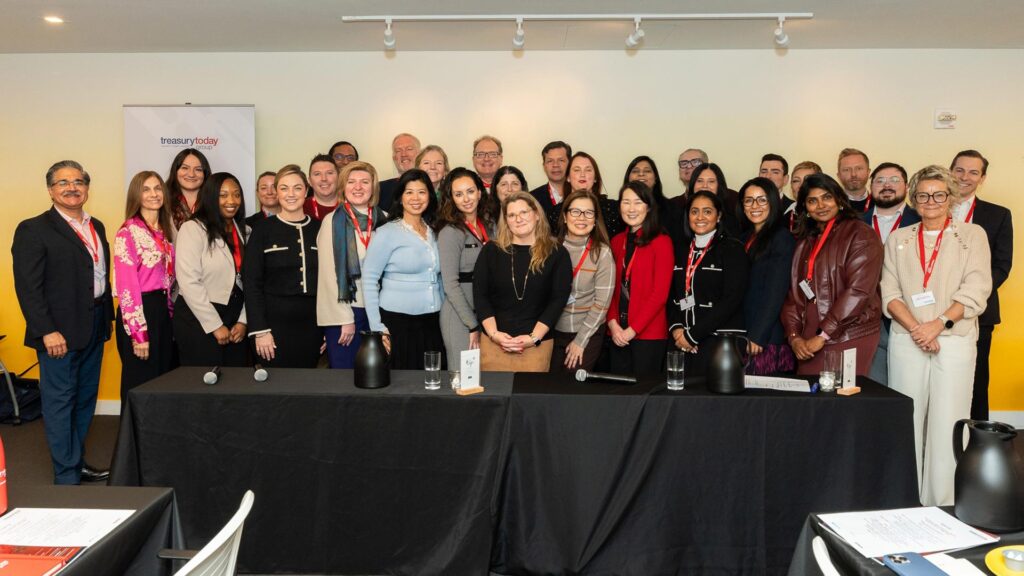
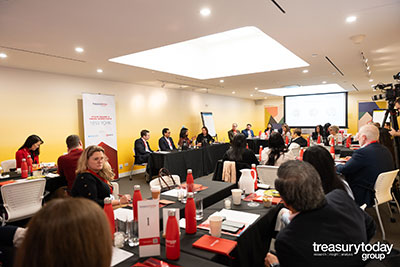
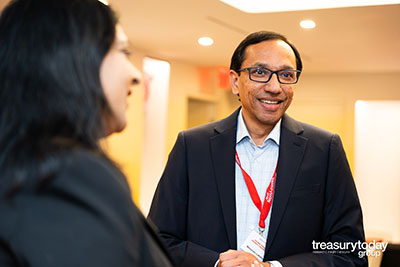
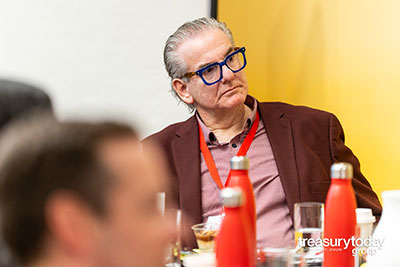
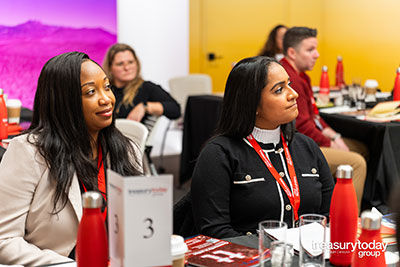
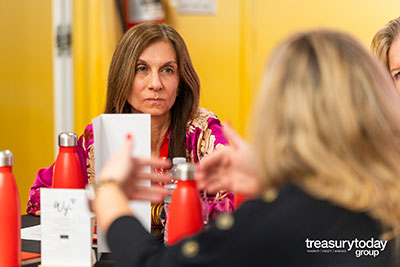
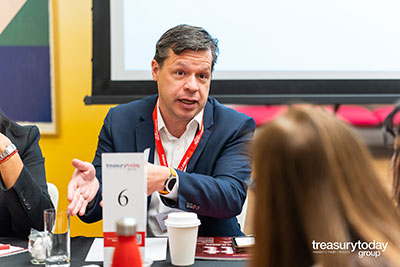
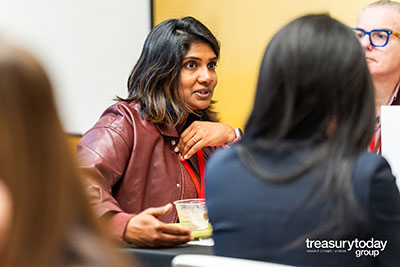
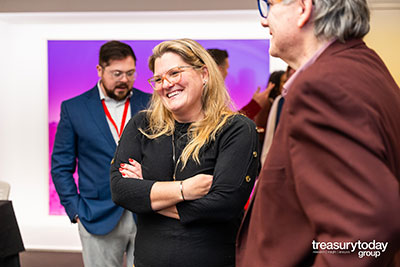
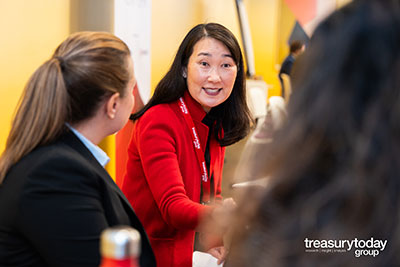
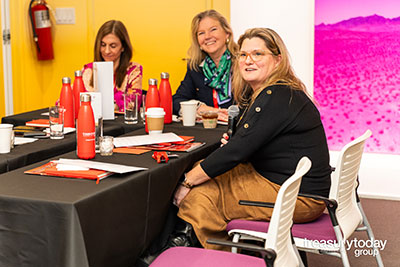
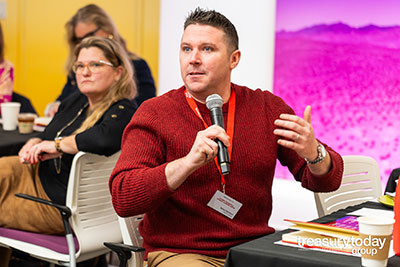
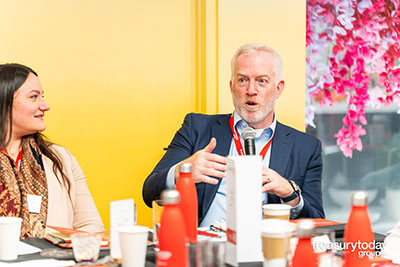
The Future Treasury & Finance Leaders Forums gather Adam Smith Award winners and industry practitioners together to foster peer connection, explore best practice and share career journeys. In 2025, the gatherings took place in five locations across the globe, and in December it was the turn of our acclaimed treasury and finance community in New York to come together, including event sponsors Barclays and MUFG.
On 4th December, Treasury Today returned to New York for the final Future Treasury & Finance Leaders Forum of 2025. In this high-impact event, treasury professionals, bankers and industry thought leaders came together to exchange valuable insights and discuss the future of treasury and finance.
Attendees enjoyed an exciting line up of sessions, including thought-provoking panel discussions on the evolution of best practice and personal development. They also took part in a series of interactive exercises, including a workshop on leadership skills and a group discussion on AI use cases in treasury.
Gaining recognition

The event kicked off with a welcome from Sophie Jackson, CEO of Treasury Today Group, and co-moderator India Gary‑Martin, Founder of Leadership for Execs.
Focusing on best practice and award-winning journeys, the first panel of the day included two distinguished Adam Smith Award winners: Sunny Gutta, Director/Treasury at Reddit, and Shreeram Lakshmanan, Director of Treasury at Regal Rexnord. They were joined by Graham Warner, Americas Head of Corporate Banking & Co-Head of Global Treasury Coverage at Barclays.
Sunny and Shreeram described the solutions that had gained them recognition in the Adam Smith Awards. For Shreeram, this was an award-winning liquidity management solution from his time at GE HealthCare. The project involved some significant challenges, including a short timeframe of around ten months to set up liquidity structures, put a forecasting process in place, “and make sure we had adequate funds to run the business on day one.” A further challenge was the need to consolidate as much cash as possible in the US.
The resulting solution included a ‘follow-the-sun’ pooling structure across multiple time zones, with cash consolidated from Asia into Europe and then to the US. Another key component of the solution was adopting an effective cash flow forecasting process to identify funding needs ahead of time.
As Shreeram explained, two factors were particularly significant in helping the treasury team achieve its goals. For one thing, the company’s leadership understood the importance of avoiding a ‘lift and shift’ mindset and instead creating something fit for purpose for GE HealthCare. “And the second thing that was critical was the support and guidance that we got from our key banking partners.”
Journeys to IPO
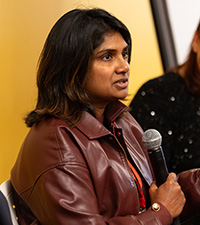
Reddit, meanwhile, was named Overall Winner in the 2025 Judges’ Choice category for the company’s successful IPO in March 2024. A defining element of the company’s IPO was a Directed Share Programme (DSP), which reserved up to 8% of the shares offered in the IPO for Reddit users and moderators, as well as friends and family of certain employees.
Sunny explained that the journey to the IPO began some years earlier. “We did have some banking relations when the company started off, and was beginning to take off, especially around 2015,” she said.
“But what we realised is we need to look ten years ahead to the IPO transaction and beyond and understand who our right banking partners would be. That’s when we started cultivating the relationships, speaking to different banking partners, and understanding what different banks can offer to us.” She added that the company has only two people in treasury, which makes it even more important to have the right banking partners in place.
Evolution of treasury
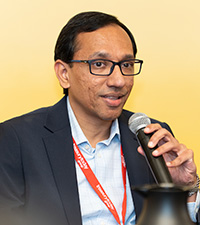
The panellists discussed the evolution of treasury from an operational to a strategic role.
Shreeram observed that the visibility of treasury within organisations has “changed drastically” in recent years: “We’re leading AR securitisation programmes, factoring, supply chain finance – it’s about getting down to where the business happens, and how you can support that.”
He noted how in many organisations, the treasury team would previously report to Tax or Accounting – “whereas now there’s increased acceptance of the specialised and strategic nature of treasury, resulting in it rolling up directly to the CFO. So, the visibility is also increasing with that.
“The second change that I see is obviously driven by technology, and the pace at which things are changing. It’s no longer just operational in nature – it’s about how you can become more tech savvy and take advantage of the tools that are there to make processes more efficient.”
Looking at the broader industry, Sunny added that treasury has traditionally been highly siloed, with its own KPIs and objectives, and limited awareness of developments elsewhere in the business. However, she said, “things have changed systematically” – both within treasury, and in terms of how organisations are using treasury. Highlighting the wealth of skills that treasury professionals bring to the table, she argued that treasurers need to build cross-functional relationships in order to make the most of those skills.
“What always strikes me when I sit down with true treasury veterans is that the changes from the last ten years are unprecedented,” said Graham. “Treasuries are becoming a value centre, but also a nerve centre, where they can tie these vast and complex organisations together.”
He explained that banks have a tendency to impose their structure and objectives onto corporates – “but that’s not the way banks should operate.” As such, Barclays has created a global treasury coverage organisation to mirror the approach that corporate clients are taking, “and to be your nerve centre within the bank.”
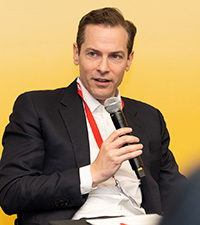
Graham added that many treasurers now have more experience of execution and strategy than some CFOs – and banks have an important part to play in helping treasurers navigate their evolving roles.
“We can help with technical evolution; we can help with the financing side of things. And in the past year, policy has been a huge part of the value that we can add – we have people in front of politicians and regulators, and we want to help you navigate that.”
In closing, Sunny observed that “most treasury folks tend to be a little introverted.” She urged attendees to view 2026 as an opportunity to “challenge yourself, put yourself out there, within your business and outside of your business.”
Impact of AI on treasury
Next, Sophie led a group discussion on the impact of AI and promising use cases within treasury and finance.
Colleen Ramsay, formerly of Amazon, advised that companies should start by understanding where they are on their data strategies, including data cleanliness, and the processes and policies currently used to make decisions. Processes are the operational steps, but policies are the rules, controls, and governance frameworks that guide decision-making. Both are critical foundations before implementing AI, especially in treasury where compliance and risk management are paramount. Companies will then be better placed to think about their short-term and long-term AI strategies.
She explained that the term AI encompasses different levels of capability. At the most basic level is the AI persona – such as a chatbot – which is useful for learning and answering questions. The next level is the AI agent, “which is the grown-up version where you’re delegating specific tasks to AI.” The most advanced level is agentic AI systems, “which represent the frontier that everyone is working toward. This is AI functioning as a teammate that can work across multiple tasks and systems to accomplish complex objectives.”
Arthur ‘Chip’ Northrop, Co-Head of Cash Management and Payment Sales, Transaction Banking Americas at Barclays, discussed the importance of leveraging AI in a way that is future proof. “Whether you’re building a treasury management system or a home-grown system, what does it look like ten years from now? And how do you leverage AI across a spectrum of projects?”
Susan Quartarolo, spoke about using programmes like OneDrive and OneNote to track meetings and get more comfortable using AI. “I’ve also implemented my team to send a monthly AI progress report, so we can track what we’re working on and the status,” she said. “It’s about not being intimidated and learning to use it as a tool to enhance your role.”
Personal journeys and navigating growth
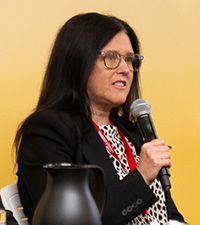
Following the group discussion, Sophie introduced a second group of panellists: Susan Quartarolo, President and Treasurer, Sony Capital Corporation; Aditi Agarwal, Global Treasury Operations Leader and Chief of Staff, GE HealthCare; and Manoj S Bhatia, Managing Director, Global Head of Subsidiary Banking, MUFG Bank.
Susan explained that after graduating from Fordham University with a degree in Finance, she started off as a Petty Cash Accountant at Condé Nast, before taking a role in Accounts Payable at ZEISS, a German optical systems and optoelectronics company. “It was a small treasury group – a Treasurer and Assistant Treasurer – and they started to ask me to back up the Assistant Treasurer,” she explained. “When she took early retirement, they promoted me – but I didn’t get the Assistant Treasurer title.”
Nevertheless, Susan realised that she wanted to stay in treasury. “I attended as many conferences as I could; I took the certified cash manager exam.” She was then headhunted for a Treasury Analyst role at shipping and mailing company Pitney Bowes.
“It was there that I was really able to build upon my foundation of all the skills I had already learned,” she recalled. “I was also seeking my MBA from Pace University in Financial Management. Shortly after I got my degree, Sony reached out to me and offered me the job as Director – and I’ve now been with Sony for 24 years.
“In 2023 I was promoted to President and Treasurer, which was the first time a female and an American had held the role.”
Harnessing AI in treasury
Turning to the significance of AI to treasury leadership, Aditi pointed out that there are people who are embracing the technology already – “but there are people who are actually shying away from it. Within my team, one thing I’m trying to tell people is, ‘don’t think this is a technology that is there to replace you. It is there to help you.’”
She shared some examples of how GE HealthCare’s treasury is already leveraging AI. “We have hundreds of SOPs (standard operating procedures). When you write one, you get very excited about it – but when it’s time to go back and refer to it, it’s difficult to find where the process is actually sitting.” To address this challenge, the team created an AI agent which sits on top of the SOPs and answer questions.
Other examples include using AI to translate documents into English from different languages. “And a third use case is where we are using AI to write some very simple macro codes for us.”
Growing more leaders
Sophie asked Manoj about the importance of self-care. He said that when he started working with Citicorp Information Technology Industries Limited in 1994, “at that induction, the first thing I learned was that ‘you work good if you feel good’. And I have tried to use that as a guiding philosophy, not only for myself, but also in terms of my leadership style with the team. I want everyone to feel good about coming to work every day.”
Manoj added that it is important to ensure that the organisation is delivering what it should – “and more importantly, as I now think about my own leadership style and my role in the organisation, I am convinced that the role of the leader is actually to grow more leaders, and not more followers.” As such, he is aiming to delegate more, and makes sure he is giving people the opportunity to become leaders themselves.
Succession planning and leaving a legacy
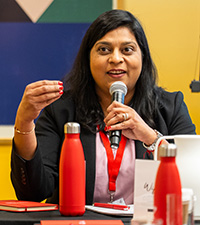
Aditi said that succession planning has been a particular buzzword for her in the last couple of years, adding that the concept is not limited to retirement planning. “We have to start thinking about succession planning, even when you are working and you’re within the organisation,” she explained.
For her, succession planning means knowing the next two moves for every member of her team. “And it may well be that a person wants to do whatever they’re doing right now for the next ten years – that’s also part of a plan. But you should know what the person wants to go into, and how you can help in growing them.
“The other aspect is to identify the roles which require niche capabilities, or the roles which can be disruptive to business if you do not have a good successor in that role. Once you’ve identified those critical roles, then you start thinking about who the next person could be to take on that role.”
Turning to the idea of leaving a legacy, Manoj explained that MUFG’s global corporate investment banking business had grown from 7% of the bank’s net profits in 2018 to 25% in 2025. “The challenge we have is how to make that sustainable,” he noted. “When I look at it from a legacy point of view, the legacy is about the values that we instil in the organisation, and more importantly, what will resonate with the next generation of bankers.
“To me, I would love to see us doing everything from an external end-client-centric point of view – that’s definitely something core that I would love to leave behind.”
Moving forward
Finally, the panellists spoke about flexibility and the importance of investing in personal growth. Discussing her experiences of reporting into Tokyo while managing teams across the US, Susan said that Sony encourages cross-collaboration, self‑reflection and continuous learning.
“I find that many other departments have no idea what treasury does, so meeting with your counterparts in other departments means you can leverage each other’s ideas and improve communication. Maybe you could add value to a project that another department is working on, and they can add value to yours.”
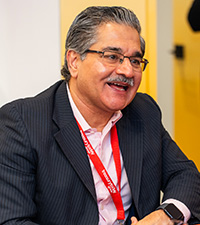
Aditi observed that “the world around is changing – so we all have to be very resilient and embrace the changes that are happening. I keep telling my team that we don’t have to keep saying ‘I’ve done it like this forever’ – we can all change.
“The other piece I’ll say is, make sure you are investing in yourself, growing yourself, and also investing in other team members or other people that you can help grow.”
Manoj concluded, “I think we are all privileged to be in the positions that we have. I very much believe in being adaptable and flexible, and trying to grow more leaders – they don’t have to be exactly our prototypes, but I think we should really be encouraging people to challenge themselves more in their organisations.”
Honing leadership skills
In the final section of the day, leadership guru India Gary-Martin led a workshop on leadership skills for emerging leaders.
She spoke about having the power to influence decisions, resources and people, legitimately and with accountability. “For me, influence or power or presence isn’t about who speaks the loudest or is the most extroverted – it’s about how you show up in the spaces you inhabit, and the influence that you have in those spaces,” she explained.
India also discussed leading with authenticity, noting that there is a difference between intention and impact. She emphasised the importance of being able to connect with people and find out what matters to them: “Knowing what people want is so critical, and sometimes you give some power to gain support.”
Turning to the topic of burnout, India highlighted the importance of recognising the signs of burnout and building resilience. “You have to understand what you can and can’t control,” she said. “The thing that I practice is making a list of things I know I can control, and then I’m not stressed about all the other uncontrollable things.”
In closing, India pointed out that people are not islands – “you have people around you, and the way to maintain your resilience is by knowing there are people you can call who can help you through the hard things.
“Things are always going to be hard – you just learn how to do hard better, with healthy optimism and self-compassion. Sometimes things go crazy, so grant yourself grace and know that every storm will run out of rain.”