Challenges and opportunities in MENA: the past that forges the present
Speaking in a personal capacity, Peters-Bühler is enthusiastic about treasury’s increasing level of maturity in the MENA region.
“Treasury is very interesting here: we see maturity happening among the banks and the product offerings that are provided in the Middle East and Africa, and we also see that the treasury community in the region as a whole is becoming more and more mature,” he says.
He adds that in areas such as risk management, compliance and technology, he views the Middle East as now at the same standard as the Netherlands, Ireland and the UK. “A lot of investment has been made in training, in the development of policies, in risk management and in treasury systems. So, in that sense, I do see that the Middle East is now at par with parts of Europe when it comes to the development of products and treasury management best practices.”
That said, he does not dispute that the region has historically been viewed as “problematic” from a treasury perspective, not least because of regulatory challenges, issues around trapped cash, and limited cash management opportunities due to non-convertible currencies.
“The main challenge in the region is restricted currencies in Africa, but things are getting better on that point as well,” opines Peters-Bühler. “I would say that governments have given up on restricting liquidity for multinationals, because they see that they are harming themselves by not allowing their multinationals to import and export freely.”
In particular, Peters-Bühler believes that growth in Africa has been hindered by a lack of tools to support international trade. “So most governments – particularly in places like Egypt, Morocco, Rwanda, Kenya and South Africa – are opening up their liquidity markets to allow companies to compete freely and be effective participants in global supply chains.”
Meanwhile, he observes that more collaboration is taking place across the Gulf Cooperation Council (GCC) countries, alongside the rise of more centralised treasuries. “Why? Because it can be done. I see fewer and fewer restrictions on the GCC currencies, and there is much more technology.”
Harnessing technology and using the ‘newly created’ critical mass
Where technology is concerned, Peters-Bühler believes that most multinationals in the region now see a treasury management system (TMS) implementation as standard, with additional opportunities for efficiency improvements springing up as new technologies emerge.
In particular, Peters-Bühler cites developments in consumer payments, “where I would say Africa and the Middle East are now way beyond Europe in payment technology, at the moment, in terms of what we do with QR codes, peer-to-peer, domestic clearing systems and touchless payments.” Likewise, he points to opportunities in the area of corporate payments, with new products continually being developed in the 60+ jurisdictions in MENA.
“Of course, what makes it easy is that most of the GCC countries are pegged to the dollar, so although they are different currencies, they are relatively stable and can be managed from a central location,” he adds. “They are convertible, they are liquid, they are widely available – but they are also relatively stable.”
An advantage of GCC currencies, he believes, is that the return on investment in these currencies is higher than the regulated liquidity pools in New York and London. “In that sense, it’s a very attractive area to invest in ADGM for cash rich companies without FX risks. That’s also why I would say we are seeing a sharp decline in the role of London usage by MENA companies.”
There are a lot of homegrown multinationals in the Middle East and Africa that demand best practices and investment from banks and fintechs.
Developing ADGM as a liquidity centre (London is no longer calling…)
Expanding on this point, Peters-Bühler argues that the Middle East has an opportunity to develop a major global liquidity centre to rival locations such as New York, London and Singapore.
“For one thing, I see a critical mass developing in the Middle East, including a lot of homegrown multinationals in the Middle East and Africa that demand best practices and investment from banks and fintechs.”
At the same time, he sees a critical mass is arising in terms of volumes between GCC currencies, alongside growing populations and consumer markets – “and this, I believe, is creating the conditions needed for the Middle East to become an area of cash management in its own right.”
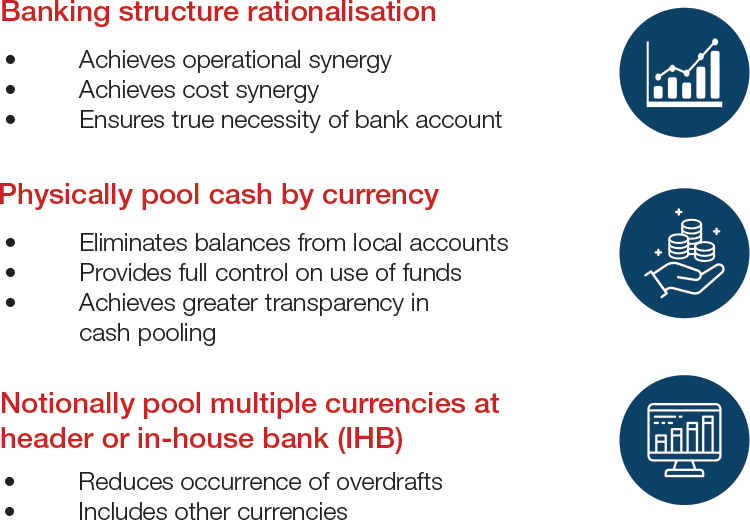
He points to several developments in the Middle East that could help to make this a reality, including the UAE’s financial free zones. “Particularly significant is the emergence of Abu Dhabi Global Market (ADGM) as a liquidity centre, alongside the development of virtual pools, in house banking-as-a-service and notional pooling,” he says. “Although there are certain limitations, like the non-inclusion of the Dirham, all other liquidity can be managed from ADGM.”
Peters-Bühler explains that bringing liquidity to the Middle East gives treasurers in MENA a readily available liquidity source: “If they have to draw on commercial paper programmes or short-term daylight overdrafts – today, US$100m – that liquidity is now available in ADGM. I also see that more market opportunities are available for investments, and the rates that are provided in ADGM are higher than in London or New York.
“So I see it as very attractive for multinational companies to keep their liquidity in the Middle East, rather than moving it to London where the end-of-day money market rates are lower – not only because of the liquidity management, but also because of regulatory issues.”
Other significant developments include the Dubai International Financial Centre (DIFC), although Peters-Bühler argues that most banks and companies are focusing their attention on ADGM: “Just as Singapore has won over from Hong Kong, I do see that most of the balance sheets of banks and companies are in ADGM, rather than DIFC.”
Likewise, he describes Saudi Arabia’s financial district – King Abdullah Financial District (KAFD) – as a “missed opportunity”, adding that he believes that Saudi Arabia has yet to develop the regulatory and compliance frameworks needed to set up a liquidity centre.
Moving on up: the value in the Middle (East)
Reflecting on his career in recent years, Peters-Bühler is enthusiastic about the opportunities to be found in the Middle East.
“I’m very happy to work here with colleagues from Egypt, Dubai, Morocco, Nigeria, Turkey, Kenya and South Africa,” he says. “There is some really high-quality talent coming into treasury in the region right now.”
As well as benefiting from training from external providers, he observes that companies in the region are taking steps to train their talent in industry best practices, with many companies investing in human resources to reduce their historical dependence on importing treasury professionals from London and Europe.
“We do see a lot of home-grown treasurers now that are well able to stand up to the turbulent currency environment that we are currently seeing, as well as understanding regulatory requirements and adopting best practices,” he says.
Looking ahead, Peters-Bühler predicts that ADGM will continue to develop as a future liquidity centre, directly competing with London and taking over the role currently played by London for many multinationals in the region. “It saves you a visa, an eight-hour flight, and high legal fees – it’s all in Abu Dhabi as of now.
“I believe the Middle East is ready to compete for best practices with treasurers around the world – and in the coming years, I think the trend will move to exporting the UAE’s Cash Management knowledge on to Europe!” he concludes.