OM Holdings’ innovative refinancing structure and timely close
Published: Feb 2026
Best Funding Solution
Overall Winner
OM Holdings Limited
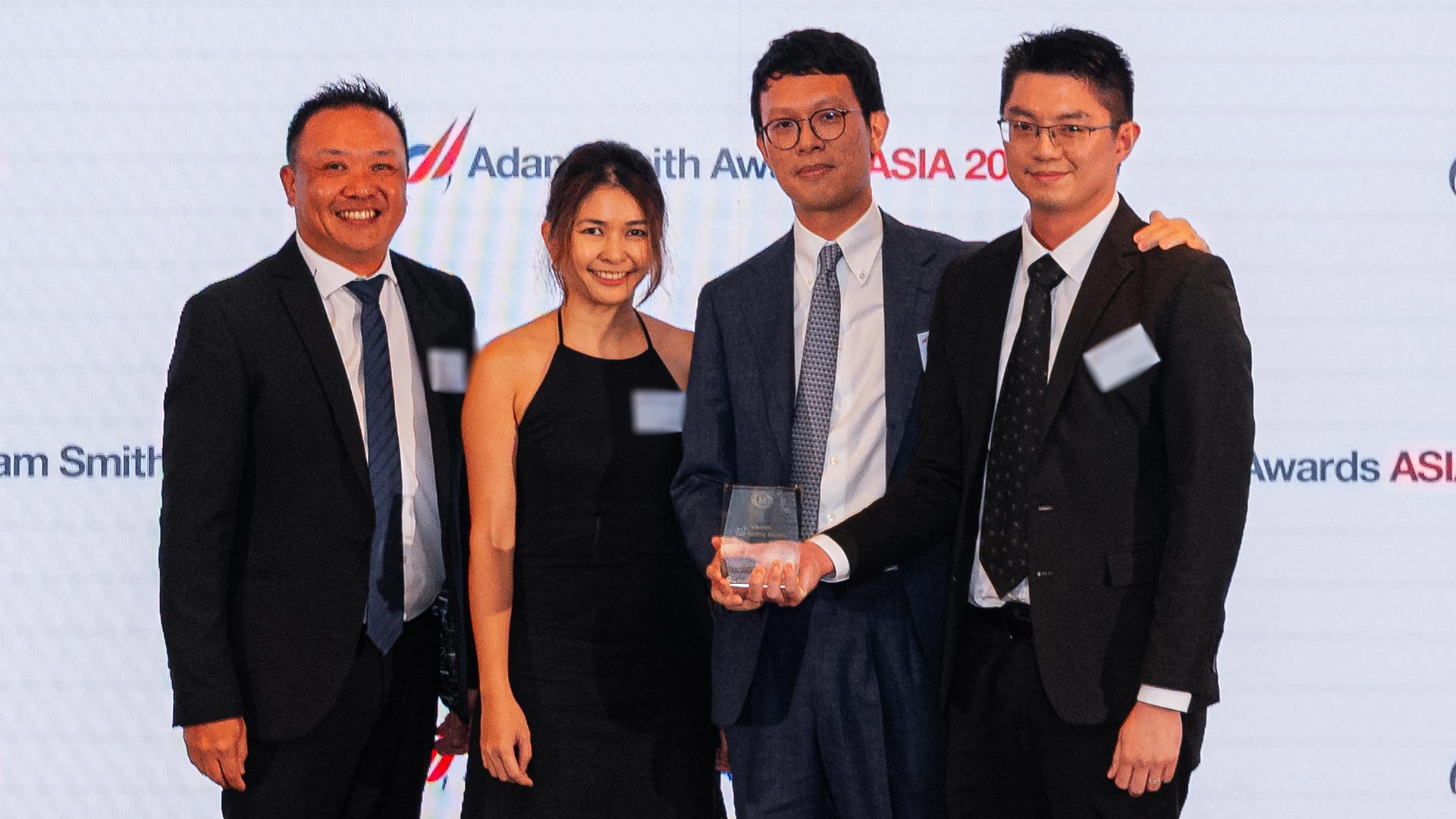
Photo of Eugene Tan, Jenny Voon, Adrian Low and Stanley Liu, OM Holdings Limited.
Stanley Liu
Director, Corporate Finance
OM Holdings Limited (OMH or the “Group”) is a manganese and silicon smelting company. The Group is engaged in the business of trading raw ores, smelting and marketing of processed ferroalloys. With 30 years in the industry, OMH is listed on both the ASX and Bursa Malaysia and has operations across Australia, China, Malaysia, Singapore and South Africa. Today, the Group is one of the world’s leading suppliers of manganese ores and ferroalloys and seeks to be the main ferroalloy supply partner to major steel mills and other industries.
The challenge
OMH embarked on an exercise to refinance its legacy project finance, comprising a US$118m long-term loan and a US$101m working capital facility. This move was necessitated by the downturn in the commodity market cycle that squeezed profit margins and reduced cash generation.
At the same time, the existing lenders required assurance that the Group’s capital structure remains financially viable and that the loan covenants were met within limits. As a public entity, OMH also needed to structure the refinancing in a way that supported its business growth and created value for its shareholders.
The financing strategy aimed to align with the Group’s strategic objectives:
Sustainable financing structure: accommodate industry volatility and establish a sustainable financing structure.
Lower financing costs: reduce financing costs and cash outflow to improve EBITDA and bottom line.
Optimised working capital: right-size trade finance and working capital limits to support procurement needs.
The refinancing exercise aimed to:
Refinance the legacy facilities.
Increase and right-size the overall credit limits for greater funding flexibility.
Improve finance margins (pricing) by at least 0.5%.
Negotiate more favourable covenants and reduced undertaking.
The deal, launched in September 2024, faced potential delays due to year-end holidays and geopolitical events, such as the US presidential inauguration.
The solution
OMH, together with SMBC as the Mandated Lead Arranger and Bookrunner, launched a new financing structure consisting of:
A three-tranche syndicated loan structure:
Trade-linked prepayment credit facility.
Revolver credit facility.
Secured term loan facility.
The structure comes with an accordion feature to allow for upsizing of funding requirements if the Group wishes to exercise.
Bilateral facilities:
“Clean” trade finance and working capital facilities.
“Clean” bank guarantee facilities.
Forex hedging limits.
The deal was successfully closed with six lenders, including two returning lenders. Despite challenges in replacing two legacy lenders who opted out due to changes in their industry risk appetite, the Group achieved:
Reduced financing cost of almost a percentage point on the loan premium.
Improved amortisation and maturity profiles to enhance profitability and cash flow.
A 40% increase in trade finance and working capital limits to support more efficient trade and supply chain operations.
Notably, the deal closed just days before a significant US tariff regime change (Liberation Day), and the lenders later commented that the syndication market experienced a “deal-freeze” situation shortly after, which would have impacted the deal if it had not closed on time.
Bank of China Limited Singapore branch, Export – Import Bank of Malaysia Berhad (EXIM) and AmBank (M) Berhad were the Mandated Lead Arrangers, and Malayan Banking Berhad (Maybank) and Bank of East Asia Limited Singapore branch were the Lead Arrangers.
Best practice and innovation
A key innovation in the refinancing was the prepayment facility, which transformed a significant portion of the previously heavily secured project finance loan into a structure backed by trade receivables, a lighter form of security for the syndication lenders. The prepayment mechanism involved the bank syndication “prepaying” future internal purchases by OMH’s Singapore trading entity to its Malaysia manufacturing entity. The Malaysian entity would then use the proceeds to repay the project finance loans, effectively “re-basing” the loans from Malaysia to Singapore.
All bilateral working capital facilities were “clean-based”, backed only by corporate guarantee.
“Given our balance sheet size, the inherently cyclical and often volatile nature of our industry, as well as coming out from a heavily secured arrangement, the clean-based lines were extremely difficult to convince, but we pulled it off in the end,” explains Stanley Liu, Director, Corporate Finance.
A significant portion of the bilateral clean working capital facilities was secured through Islamic financing with EXIM Malaysia, marking the Group’s first Islamic financing structure. The new structure transits from a conventional financing structure, and replicates the existing trade products, including:
Letter of Credit (LC) into Wakalah.
Trust Receipts (TR) into Murabahah.
Bank guarantees (BG) into Kafalah.
A bridging facility (Tawarruq) was also set up to smoothly transition previously utilised issuances until their expiry. This innovative approach allowed the Group to diversify its funding sources and optimise its capital structure.
Key benefits
Cost savings.
Risk mitigated.
Future-proof solution.
Exceptional implementation (budget/time).
Improved key performance indicator (KPI) metrics.
The Adam Smith Awards Asia are the industry benchmark for best practice and innovation in corporate treasury. To find out more please visit treasurytoday.com/adam-smith-awards-asia