

Home

Redefining how corporate treasury manages multi‑dimensional risk at Gedeon Richter

Published: Sep 2026
Adam Smith Awards 2026

Best Risk Management Solution

Overall Winner

Gedeon Richter Plc

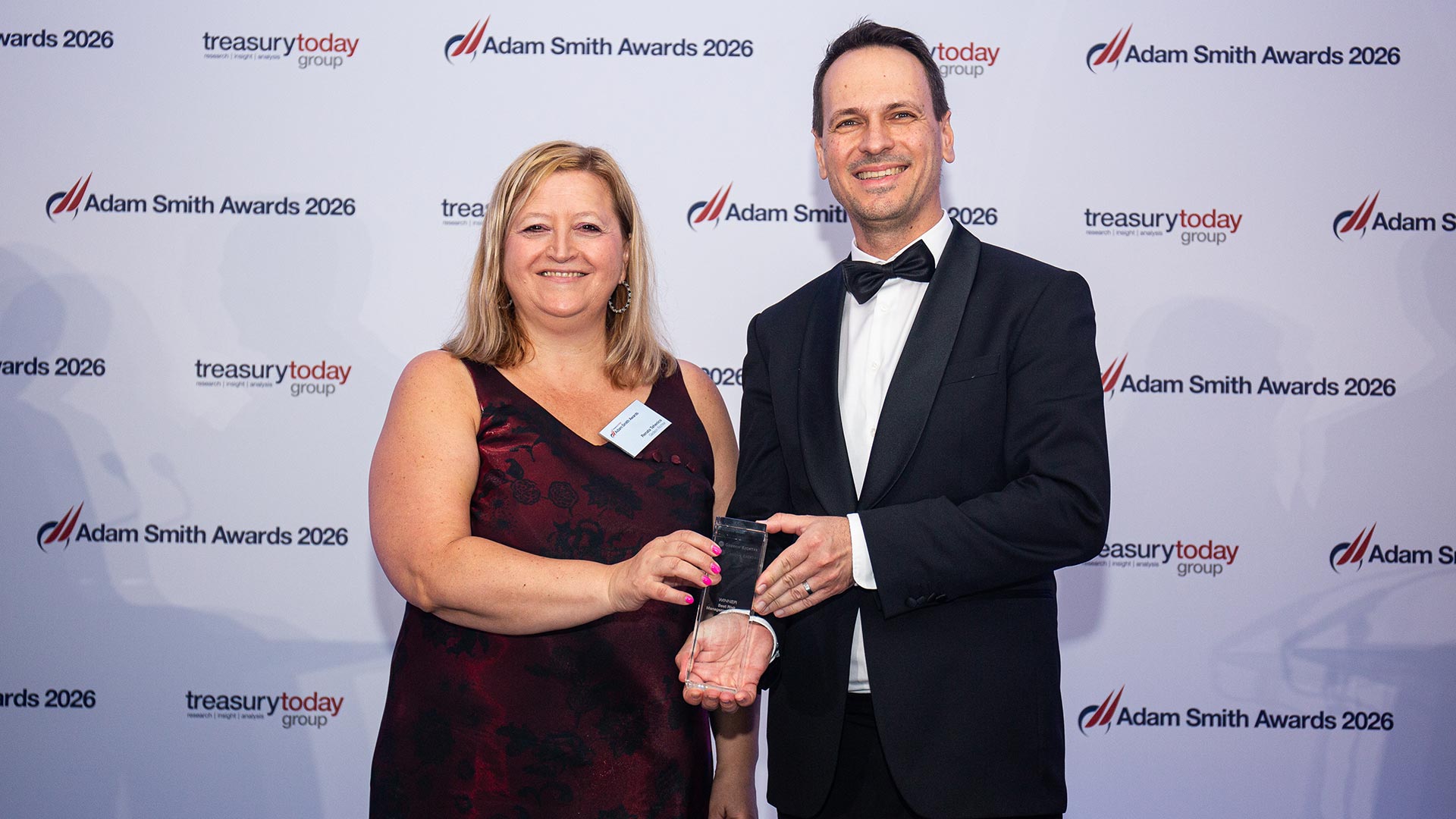
Photo of Renata Tehenics and Gabor Szucs, Gedeon Richter Plc.

Gabor Szucs

Director of Financial Operations
Gedeon Richter Plc logo
Hungary

Gedeon Richter Plc is a European multinational pharmaceutical and biotechnology company headquartered in Budapest, Hungary. Founded by Hungarian pharmacist Gedeon Richter in 1901, the company has grown to operate in over 100 countries.

The challenge

Before implementing the solution, Gedeon Richter faced an increasingly unsustainable risk landscape. For decades, electricity had been a stable, low volatility input managed by technical procurement teams.

This changed abruptly after the post COVID energy shock, when geopolitical tensions triggered extreme and persistent price volatility. Electricity became a strategic commodity risk, exposing the company to budgeting uncertainty, supply chain fragility and sovereign dependence due to its location in a fossil fuel import dependent region.

At the same time, the company’s decarbonisation efforts created ESG and reputational challenges: renewable electricity was already sourced through a combination of self-generated solar power, the green component of standard utility supply and separately purchased Guarantees of Origin. However, these measures were no longer sufficient to support the company’s increasingly ambitious sustainability targets. Conventional hedging tools (FX and gas) were insufficient because Hungary’s fossil heavy generation mix caused gas and power prices to move together, leaving electricity exposure structurally unhedged. The company therefore faced a dual challenge: increasing pressure to accelerate decarbonisation while remaining highly exposed to electricity market volatility. This convergence of commodity volatility, energy security concerns, ESG pressure and accounting risks (potential IFRS derivative volatility under alternative structures) created a clear need for a new approach.

Because electricity risk had outgrown procurement it required a treasury led, financially engineered solution that could stabilise costs, secure domestic renewable supply and deliver verifiable decarbonisation.

The solution

The solution was a treasury designed, three year offsite physical Power Purchase Agreement (PPA), structured as a long-term commodity risk hedge and an integrated financial, operational and ESG risk management instrument.

The treasury selected this model after evaluating all viable alternatives – own renewable generation, stand alone Guarantees of Origin, physical PPAs and Virtual PPAs (VPPAs). The PPA was chosen because it uniquely combined price volatility reduction, domestic supply chain security, credible decarbonisation and IFRS compliant accounting stability, whereas other options either lacked verifiable ESG impact, exposed the company to market based financial volatility, or failed to provide long-term supply assurance.

Implementation began with a treasury led market assessment and a two stage tender process. An initial RFI attracted 30+ bidders across solar, wind and hybrid profiles, followed by a structured RFP assessing pricing models (fixed, indexed, pay as produced), contract tenors, counterparty strength and delivery/balancing obligations.

Ultimately, the PPA was implemented as a scalable pilot, forming the foundation for future physical PPAs and potential VPPA style hedging layers, enabling the company to proactively manage commodity, supply chain, ESG and accounting risk through a unified treasury led framework.

Best practice and innovation

The judges saw Gedeon Richter as a truly standout winner for treasury’s role in securing energy security for this pharmaceutical company hitherto reliant on fossil fuels. The solution redefines how corporate treasury manages multi‑dimensional risk in an environment where traditional hedging tools were insufficient.

Instead of treating electricity procurement as a procurement issue, treasury reframed it as a strategic risk category encompassing commodity volatility, supply chain fragility, sovereign/geopolitical exposure, accounting volatility and ESG linked reputational risk.

The physical PPA itself is innovative not simply as an energy contract, but as a risk engineered instrument; it stabilises long-term commodity exposure without triggering IFRS derivative accounting, thanks to deliberate structuring under the IFRS 9 “own use” exemption. Its hybrid solar-wind generation mix provides natural diversification, reducing weather driven production variability. It replaces a single point of failure reliance on imported fossil energy with a domestic, traceable, auditable supply, materially lowering supply chain and sovereign risk.

Guarantees of Origin ensure verifiable Scope 2 emission reductions, transforming ESG from a reporting obligation into a controlled risk parameter.

Key benefits

  • Process efficiencies.

  • Future-proof solution.

  • Improved key performance indicators (KPIs) or metrics.

  • Improved visibility.

The solution has fully met – and in several areas exceeded – the original aims of stabilising electricity related financial volatility, strengthening energy security and delivering credible decarbonisation. The physical PPA provides long-term price visibility through fixed base pricing with moderate indexation, significantly reducing exposure to spot market swings and improving budget reliability.

This directly addresses the volatility that triggered the need for a new approach. The shift from imported fossil fuel based electricity to domestic renewable supply has strengthened operational and geopolitical resilience, reducing exposure to sovereign and supply chain risks that previously affected long-term planning.

The hybrid solar wind structure has improved alignment with industrial load, enhancing reliability compared to single technology options.

The solution is impactful because it transformed uncertainty into long-term stability for the organisation and its people. The collaboration broke down silos, built new capabilities and restored confidence across the business. The project not only stabilised cost and supply risks, but also empowered teams with a scalable, future-proof risk management framework.

Adam Smith Awards sail

The Adam Smith Awards are the industry benchmark for best practice and innovation in corporate treasury. The 2026 awards attracted 635 nominations. To find out more please visit treasurytoday.com/adam-smith-awards

Join our global community

Creating a free account helps us to understand our community better, and tailor our content and events to suit your needs. You can unsubscribe at any time.

Already have an account? Sign in

Search for your company; if not found, select 'Other' and enter it manually below
  • • At least 8 characters
  • • At least 1 uppercase letter (A-Z)
  • • At least 1 lowercase letter (a-z)
  • • At least 1 digit (0-9)