


Home

How Siemens treasury made cash management programmable

Published: Sep 2026
Adam Smith Awards 2026

Best Cash Management Solution

Highly Commended Winner

Siemens

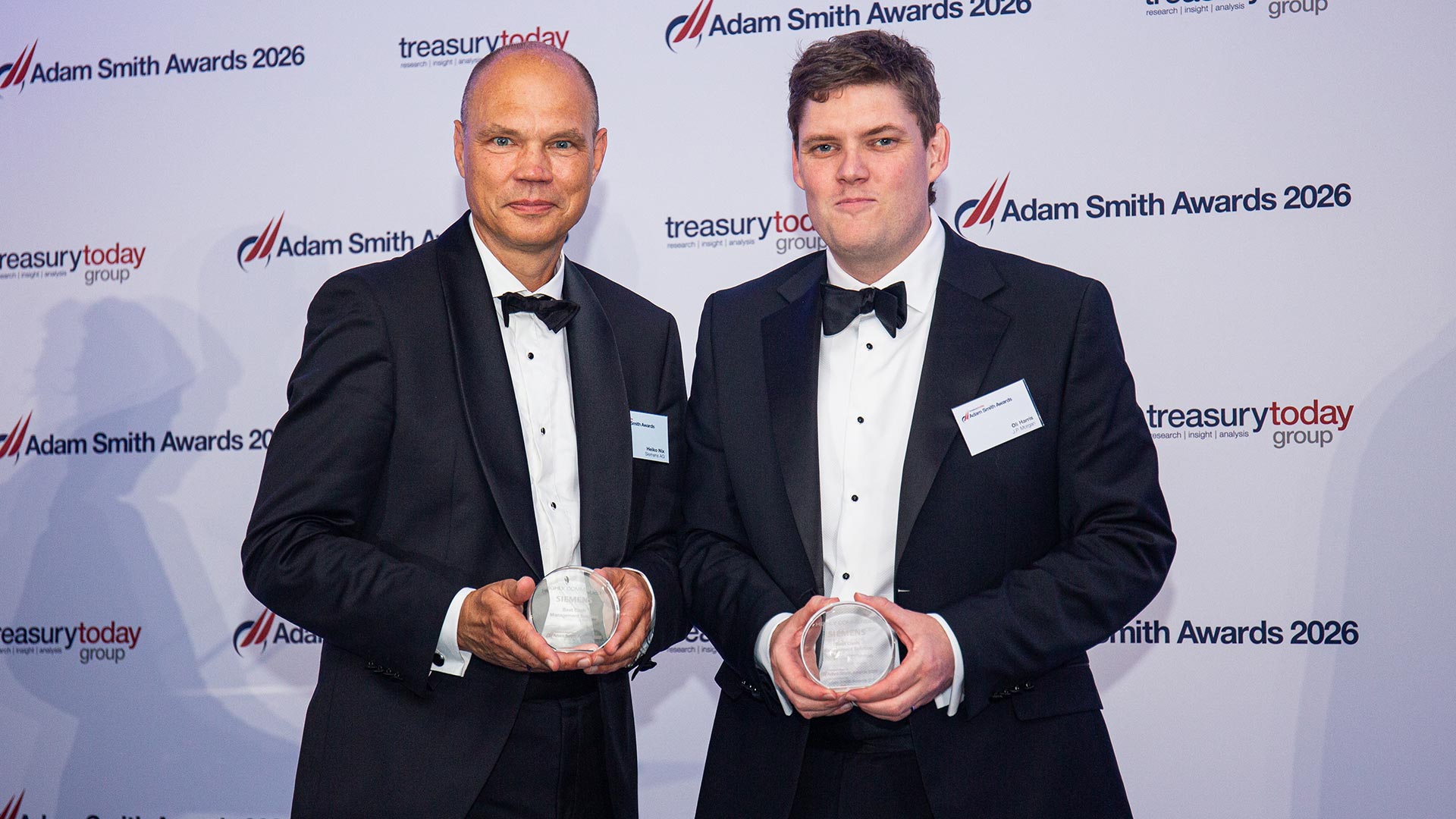
Photo of Heiko Nix, Siemens and Oli Harris, J.P. Morgan.

Heiko Nix

Global Head of Cash Management & Payments
Siemens logo
Germany

Siemens AG is a leading technology company focused on industry, infrastructure, mobility and healthcare. The company’s purpose is to create technology to transform the everyday, for everyone.

By combining the real and the digital worlds, Siemens empowers customers to accelerate their digital and sustainability transformations, making factories more efficient, cities more livable, and transportation more sustainable.

in partnership with

Kinexys by J.P. Morgan

The challenge

Over decades, Siemens’ global cash management architecture evolved to maintain hundreds of bank accounts across numerous jurisdictions and banking partners, with differing connectivity models. Many financial processes still relied on invoices, payment runs and batch-based reconciliation.

Meanwhile, Siemens’ industrial operations are becoming digital and data-driven, with machines, platforms and services generating business events in real-time, while instant payments were moving financial flows towards a 24/7 environment.

The challenge was to automate financial processes so that they could operate continuously and respond to events as they occur, without depending on manual intervention or fixed processing cycles.

The solution

Automating processes means making them programmable. Liquidity must be available around the clock, the accounts holding it must be addressable, and account data must be actionable rather than merely reportable.

Tokenised deposit accounts, implemented with Kinexys by J.P. Morgan, hold regulated commercial bank money that can be moved between accounts in real-time, independent of clearing windows and cut-off times, covering US dollars and euros.

A global virtual account structure sits on top of them, separating the logical account hierarchy from the physical one while preserving transparency across entities. Because its header accounts are themselves tokenised deposit accounts, real-time availability is a property of the architecture, not of a single specialised account within it.

Within this architecture, application programming interface (API)-based connectivity replaces file and batch-based communication. Balances, transaction data and payment execution are available in real-time, and every instruction returns an immediate confirmation. It is this feedback loop that allows a process to continue rather than wait for the next statement or manual intervention.

Best practice and innovation

With this infrastructure in place, the account layer could carry data and rules.

Programmability means that the money movement logic sits with the money itself. Execution follows from a condition rather than from an instruction. The condition is held at the banking layer and evaluated against the actual state of the account. Kinexys built the capability; Siemens defined the use case, the rules and the way it would be operated.

The first rules focused on liquidity. One funds an account when a payment falls due that the balance cannot cover. The other draws from a central funding account whenever the balance falls below a defined level. They run on the same account, independently of each other, and neither requires an instruction to be raised upstream.

Both outcomes could be achieved with conventional instant sweeps. A sweep is agreed once and implemented by the bank, while here treasury writes and changes the rule itself, within thresholds, limits and controls it sets.

Siemens treasury now operates pool structures it sets up and modifies itself, without a bank-side implementation cycle for every change. The legal and tax framework is unchanged; what disappears is the wait for someone else to build it.

The condition is defined rather than scheduled, so concentration is no longer tied to a single daily window. Treasury can pool on the state of the accounts, at a fixed time, or both.

Key benefits

  • Cost savings.

  • Headcount savings.

  • Process efficiencies.

  • Return on investment (ROI).

  • Risk mitigation.

  • Exceptional implementation (budget/time).

  • Future-proof solution.

  • Improved key performance indicators (KPIs) or metrics.

  • Improved visibility.

  • Increased automation.

  • Increased system connectivity.

  • Manual intervention reduced.

  • Reduction in errors.

The foundation delivered benefits of its own. The virtual account structure removed most of the administrative work attached to physical accounts, along with the sweeps between them, while API connectivity made positions visible in real-time and available to the systems that act on them. Around-the-clock availability is becoming a requirement rather than a refinement as instant payment schemes expand and flows stop respecting clearing windows.

The programmable layer changed the work itself. Defining and supervising rules has replaced executing individual transactions, which has reduced both effort for cash management and the errors that come with repetitive processing.

“We used to be a support function executing batch-driven payments,” says Heiko Nix, Global Head of Cash Management & Payments. “As those processes become increasingly automated and always on, we can move beyond execution and provide a capability that new business models can be built on.”

Akshika Gupta

Global Head – Product Sales & Solutions, J.P. Morgan

Faced with a highly complex global cash management environment, Siemens treasury fundamentally redesigned its architecture to support an automated, always-on treasury solution. The solution allows for instant, cross-border, tokenised settlements and 24/7 liquidity management, without being constrained by local banking cut-off times. By implementing Kinexys by J.P. Morgan, virtual accounts, API-based multibank connectivity and AI-enabled cash application, Siemens treasury automated reconciliation, improved liquidity management and evolved from a supporting role to a business driver. The project even pioneered programmable financial infrastructure to automate cash allocation, intercompany funding and liquidity concentration. We applaud Siemens for building a scalable, digital treasury foundation for the future, and, on behalf of J.P. Morgan, we congratulate the entire team on this highly commended award.

in partnership with

Kinexys by J.P. Morgan
Adam Smith Awards sail

The Adam Smith Awards are the industry benchmark for best practice and innovation in corporate treasury. The 2026 awards attracted 635 nominations. To find out more please visit treasurytoday.com/adam-smith-awards

Join our global community

Creating a free account helps us to understand our community better, and tailor our content and events to suit your needs. You can unsubscribe at any time.

Already have an account? Sign in

Search for your company; if not found, select 'Other' and enter it manually below
  • • At least 8 characters
  • • At least 1 uppercase letter (A-Z)
  • • At least 1 lowercase letter (a-z)
  • • At least 1 digit (0-9)