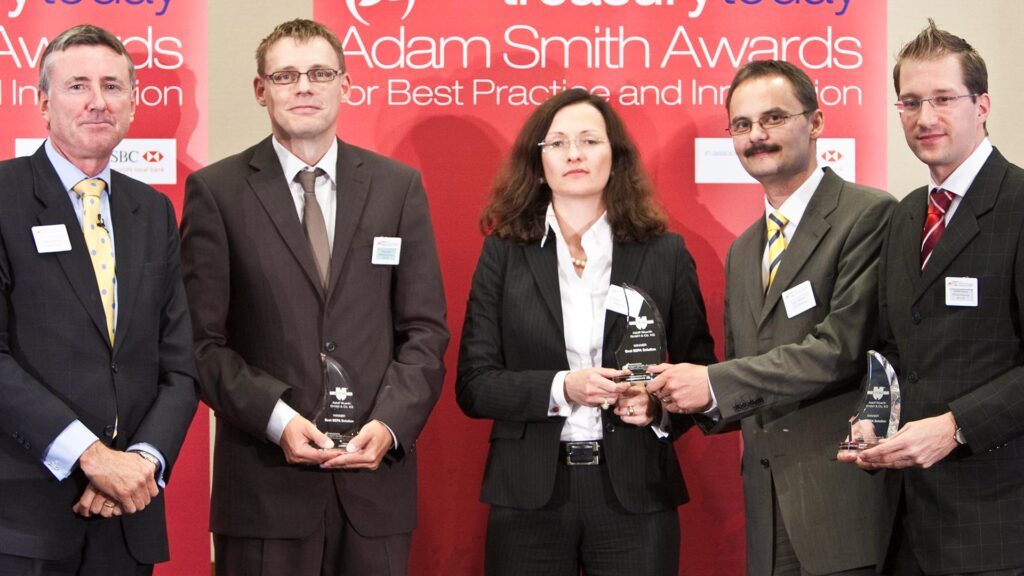
When SEPA was launched in 2008, Würth’s electronic banking software was no longer maintained and was therefore not able to support the new SEPA formats. This made it necessary for the company to review its technology needs in order to maintain and extend the service level provided to the subsidiaries. “We are the shared service centre for a couple of subsidiaries and must meet their needs,” comments Claus Wild, Project Manager Introduction for Payments.
Würth’s German headquarters manages payments for approximately 60 subsidiaries and nearly 200 bank accounts with 18 different banks. Payments are initiated either directly in the company’s SAP system or, in the case of urgent payments, via partially integrated electronic banking software.
The new solution had to meet the company’s compliance requirements and provide increased levels of automation and straight through processing. For Würth, which handles up to 15,000 incoming payments each day, the faster processing of payments was a priority – particularly as the company’s credit risk procedures prevent higher risk customers from placing orders if a payment for a previous order has not yet been received or reconciled.
After evaluating all the available solutions appropriate for a company of its size, Würth opted to pilot a new solution, which consisted of a SWIFT connection in combination with SAP’s new application (SAP Bank Communication Management). The Bank Communication Management application enables the company to link its ERP system directly to all relationship banks through one single interface.
“With SWIFT’s FileAct or FIN messages we are no longer bound by country specifications or by our software.”
Wild views the new payment solution and SWIFT connection as a long-term investment. “Over the past decade we had to update the software used in our payment processes five or six times, which has been comparatively expensive in terms of new interfaces and overall time and costs. We therefore decided to undertake a major investment in our payment processes in order to be positioned for the future,” he explains. “With SWIFT’s FileAct or FIN messages we are no longer bound by country specifications or by our software.”
Würth chose to work with Commerzbank due to the company’s long-standing relationship with the bank, as well as the bank’s technical expertise.
Würth is connected to SWIFT via a MA-CUG (Member Administered Closed User Group) provided by Commerzbank, with the SWIFT connection hosted in-house. An additional MA-CUG has since been set up with another of Würth’s banks, and further MA-CUGs are planned.
As well as working with Commerzbank on this project, Würth also worked closely with a number of other parties, including SAP and SWIFT, in order to integrate each of the different elements of the solution. As project leader, Wild oversaw the co-ordination of all the parties involved, which was managed by organising a series of status meetings and keeping parties involved by email.
While SEPA compliance was a major driver for the project, the solution has also brought a number of other benefits to Würth. “One of the goals was to improve our incoming payments,” says Wild.
“With SWIFTNet we are now able to post the incoming payments as soon as possible. Another highlight with SWIFTNet is the fully automatically delivery and allocation of SWIFT MT942 files in SAP. It’s a competitive advantage for our company in our daily business.”