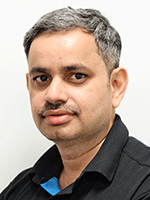
Treasury and beyond
When Kiran Yanamandra started his career as a Management Trainee in Corporate Treasury, more than two decades ago, little did he know that he would spend the majority of the next twenty years building a career that is rooted in Corporate Treasury, steering Global Treasury operations for two of the largest Indian companies, through a maze of transformation and growth amidst unprecedented volatility in financial markets. Nor did he realise that, mid-way through his career, he would have to think beyond Treasury and expand his remit beyond Treasury to larger and broader roles in Corporate Finance.
Kiran joined as a trainee in the middle-office of Corporate Treasury in Dr. Reddy’s Laboratories Ltd., a global pharmaceutical company, and over time grew within the organisation to become Group Treasurer in 2017. In the path to this leadership role, he took a three-year detour from Treasury and assumed the role of Head of Finance for the company’s German operations, based in Augsburg, near Munich.
“This was a critical milestone in my transition to a leadership role, as the stint provided me with international exposure as well as a closer association with a business role,” he recalls. “Germany had a starkly different work-culture as compared to India and that exposure made me more open and adaptable to different environments and stood me in good stead for senior leadership roles further down the road.”
Kiran returned from Germany to the headquarters to assume the role of Global Head of Treasury, Insurance, Risk Management and M&A and was inducted into the Finance Steering Committee, which comprised of the Senior Leadership Team of Finance.
After spending about 18 years at Dr. Reddy’s, Kiran decided to move to Bajaj Auto Limited as Vice President, Head of Treasury and Corporate Finance and has been leading the Treasury transformation agenda at Bajaj Auto.
“When the time comes, it comes!” he quips recalling the move to Bajaj Auto after a long association with Dr. Reddy’s.
Across the two organisations, Kiran has developed extensive experience in areas of FX risk management, cash and liquidity management, investments, fund raising, transaction banking, capital allocation, M&A, enterprise risk management, financial planning and controlling. Kiran completed his MBA at the Jamnalal Bajaj Institute of Management Studies, one of the premiere business schools in India, and later went on to complete courses in FRM and CFA. Reflecting on his academic pursuits, Kiran believes that for a technical field like Treasury, having a solid foundation of textbook fundamentals is a critical strength. “Experience delivers better when built on strong academic fundamentals,” he says.
Saving KTM from insolvency
Asked to pick the most challenging assignment that he has delivered; Kiran rates his assignment to raise financing for the acquisition of KTM as the most cherished accomplishment. He explains that although he has raised financing in international loan markets on numerous occasions in his career before, never had the constraints of time and conditions been so adverse nor were the consequences of failing to meet the timeline so severe. Bajaj had a minority stake in KTM, the Austrian motorcycle company. But as a liquidity crisis forced KTM to file for voluntary restructuring, it needed a cash infusion in excess of €800m within a short time to avoid insolvency. “The challenge was that we had only two weeks’ time to raise funds and deposit the money with the liquidator and slipping on the deadline by even one day would have pushed KTM into insolvency irreversibly,” he recalls. While Bajaj was cash-rich, exchange control regulations in India prevented Bajaj from using its cash or providing any support for fund raising in such a short time. Faced with the challenge of raising ~ €600m in a matter of two weeks to protect KTM from liquidation, Kiran struck bilateral deals with four international banks to raise bridge financing for about €660m to meet the initial deadline for cash infusion with the official liquidator. He later went on to refinance the bridge loan with a term loan from a club of international banks. J P Morgan was one of the lead participants in both the bridge and the take-out.
Not wasting a crisis
Once Bajaj acquired control of KTM, the job had just begun for Kiran and the Treasury team. Having been rescued from liquidation, KTM still required immediate liquidity support to get its operations back on their feet. Further, KTM had a complex organisation and banking structure, with about 270 bank accounts across 70+ legal entities and about €60m of liquidity trapped in the accounts. The crisis presented an opportunity to revamp the entire banking architecture while reinstating sources of liquidity. “It’s important not to waste a crisis,” remarked Kiran, “so along with KTM Treasury team, we set out on an agenda of transforming the entire cash-management structure of KTM”. Rationalising bank accounts, automated FX conversions at pre-negotiated spreads, cash-concentration through automated sweeps, multi-currency notional pooling and renegotiation of bank charges were part of the toolkit in the transformation agenda. To improve liquidity, the team introduced a new pan-Europe Receivables Purchase facility with the help of J P Morgan. KTM is well on its way to achieve its target of reducing the number of Bank accounts to 99 and trapped liquidity in bank accounts to €10m by end of the year.
Aligned with Transformation at Bajaj Auto Treasury
The chance to restructure KTM treasury came at an opportune time as Bajaj Auto was in the midst of a transformation of its own treasury, a roadmap that Kiran had set over a year before the KTM acquisition. With close to half of Bajaj Auto’s revenues coming from exports, predominantly from emerging markets in Africa, Latin America and Asia, the process and time span for collection of receivables from customers was very complex and lengthy. Adding to this was the regulatory requirement for manual declarations to be given to Banks in India under exchange control restrictions before receipts could be credited to the accounts. Kiran set up a series of initiatives to streamline the collection process – from insisting on clauses on re-imbursement timelines on LCs, negotiating tight timelines for document processing and credit by banks to the use of virtual accounts and standing instructions for credit of funds based on virtual accounts. Each step in the process-chain was evaluated to either eliminate the step or to make it straight-through. Eventually, the average collection time from date of sailing for a sight LC was reduced from about 24 days to 14 days, resulting in a reduction of receivables and the release of liquidity by about US$50m.
During this exercise, Kiran realised the stark gap in technological improvements between domestic payments and cross border payments. While domestic payments have seen game-changing improvements, with most countries having some form of real-time and 24/7 payment mechanisms, be it UPI and RTGS in India, Faster Payments in UK or SEPA in Europe, cross-border payments have seen no major breakthrough in the last two decades.
“Banking and Payments is the only leg of International Trade which does not function on weekends. Can you imagine ports and shipping lines being closed on weekends? I can ship goods on a Saturday but I cannot receive payment,” remarks Kiran, commenting that cross-border payments is an area where disruptive change can take place.
Role of a Treasurer
“Treasury is different for different organisations,” he says, while commenting on the role of Treasury. From his own experience, he has seen different parts of Treasury having different weighting in the two organisations he has worked with. In Dr. Reddy’s, with 80% of global revenue coming from outside of its home market and exposure to multiple currencies, hedging Foreign Exchange risks was the largest part of the Treasury mandate. Kiran was instrumental in setting up the currency hedging desk with adequate dealing infrastructure, formulation of a formal Hedging policy, pooling of currency risks from multiple entities into the parent entity, enabling the central Treasury team to assume and hedge currency risk for all its global subsidiaries. On the other hand, for Bajaj Auto, the treasury priorities revolved around investing its ~ US$2bn cash reserves, along with enabling exports growth through securing banking lines for LCs and faster realisation of funds. For a financial company like Bajaj Auto’s own retail financing subsidiary, Treasury was synonymous with Borrowings and other forms of fund-raising.
However, the common thread that runs across all organisations is that the Treasury function invariably has the potential to be a strategic partner to the Business. And the primary role of the Treasurer is to fully realise this potential.
Looking forward, Kiran believes that the race to protectionism is the most immediate threat to global trade. “This can reverse decades of development rooted on eliminating trade barriers.”
Asked how he is managing the current volatile markets driven by the geopolitical events and trade wars, he reminds us that “Black Swans are no longer Black Swans”. He goes on to explain, “If you look back over the last two decades, there has been a large global crisis every five to six years. Global Financial Crisis in 2008, Taper tantrum in 2013, Covid in 2019 and Tariff war in 2025 followed by the war in Middle East. While we may not be able to predict the shape and form of the next crisis, that there will be one every few years should not come as a surprise. The earlier we accept this, the better prepared we will be for the next one.”