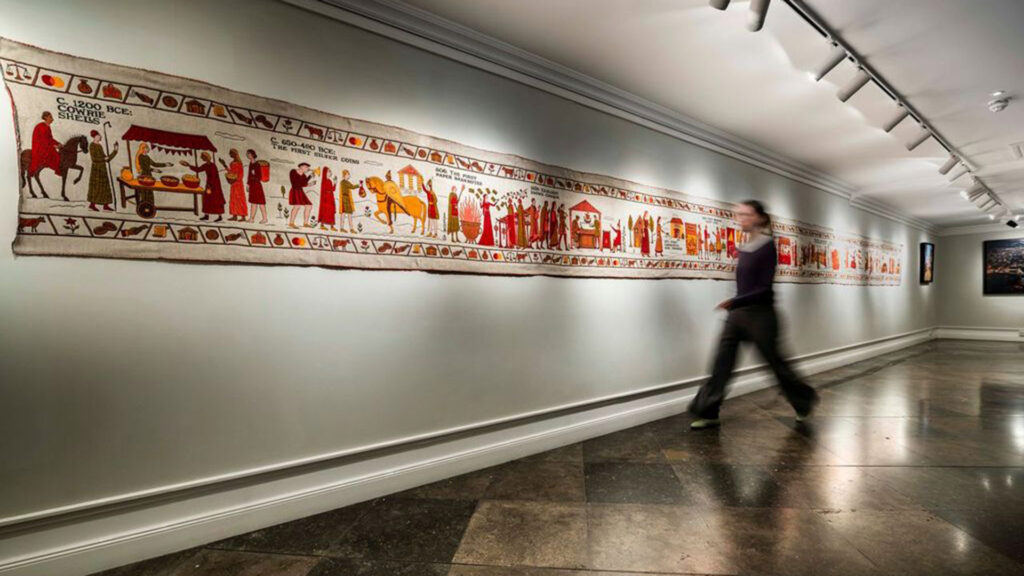
Depicting machine-to-machine (M2M) payments and robotic autonomous commerce in the same style as the famous Bayeux Tapestry, Mastercard’s ‘Payeux Tapestry’ drew a crowd to the prestigious Royal Exchange old stock exchange venue in the City of London on 7 September for an exclusive launch event attended by Treasury Today.
While the queues didn’t match those outside the British Museum where the real thing is on loan from France, the Mastercard event did have a serious point.
Their tapestry (see picture) was created by artist Mia Hansson over three months to tell the story of how humanity has gone from silver coins in 650-490 BCE through to imminent machine-to-machine (M2M) payments and robotic autonomous commerce.
As artificial intelligence (AI) becomes the latest technological advance of humanity embroidered into the panels – after bank notes, contactless and earlier payment advances – the implications for the future of business, work, payments, retail, treasury and commerce are profound.
The modern artwork accompanies some new research unveiled by Mastercard UK in London that shows:
-
One in ten consumers will routinely use AI to shop and pay by 2030.
-
AI-driven consumer spending will hit £370bn a year globally by the end of the decade.
-
A third of teenagers said they’d hand over control to a fully AI-run shopping assistant to choose and pay for products. That is a large amount of implied trust that should be earned.
-
KYC will be joined by Know Your Agent (KYA) compliance drivers.
-
Dynamic pricing may become common as agentic AI agents acting at scale on behalf of multiple users negotiate discounts. This and automation will transform the supply chain.
Entitled ‘A Short History of the Future of Shopping and Payments’, the 2026 Mastercard report unveiled in London, UK, alongside the ‘Payeux’ artwork, surveyed 13,000 kids and 13,000 parents across Europe. It additionally canvassed the opinions of four leading futurologists about the direction of travel.
“Tokenisation, trust and verifiable intent will be needed in this era of AI,” said Agnes Woolrich, SVP MasterCard UK, speaking at the press event, while extolling the technology’s “transformational potential.”
Tokenisation will be crucial
“To ensure a trusted AI-enabled purchasing, payment and treasury ecosystem can develop for consumers and merchants tokenisation will be crucial,” she said, while stressing that agentic AI in payments, commerce and finance can only live up to the hype if the trust element is there.
An end-to-end agentic AI-enabled payment is enacted by medieval-looking peasants and nobles in the artwork unveiled in London. They presumably have identified their respective bona fides to each other with a digital certificate on a blockchain, or been on-boarded as legitimate.
Speaking exclusively to Treasury Today Group at the London press event, Woolrich stressed that Mastercard wants to be an enabler in this evolving Agentic AI shopping, merchant and payments world – the orchestration layer provider – that reassures users it is safe, secure, frictionless, connected and worthwhile to participate.
“Tokenised deposits, perhaps stablecoins for corporates and other types of abstraction, will play a role. Look at our recent Mastercard acquisition of BVNK for an example of how stablecoins may provide an on/off ramp between decentralised finance (DeFi) and traditional finance (TradFi) structures,” she said
Who will be the winner on this nascent battlefield, with various AI agents battling each other – and more traditional ways of doing business – still remains to be seen.
Some incumbents may fall by the wayside, just like the defending King Harold of England who then had to withdraw from the 1066 Battle of Hastings, while a newcomer in the form of William Duke of Normandy, took over. There may be some new players in 21st century retail, commerce, payments and banking as AI technology develops, so incumbents will no doubt be fortifying their positions.
Treasurers are already using AI to aid cash flow forecasting (CFF) and can expect to see it feature much more among their partners and in the front- and back-end of the supply chain in future years. Let battle commence.