

Home

Implementing a dynamic counterparty exposure management framework with ASML

Published: Sep 2026
Adam Smith Awards 2026

Best Risk Management Solution

Highly Commended Winner

ASML Netherlands BV

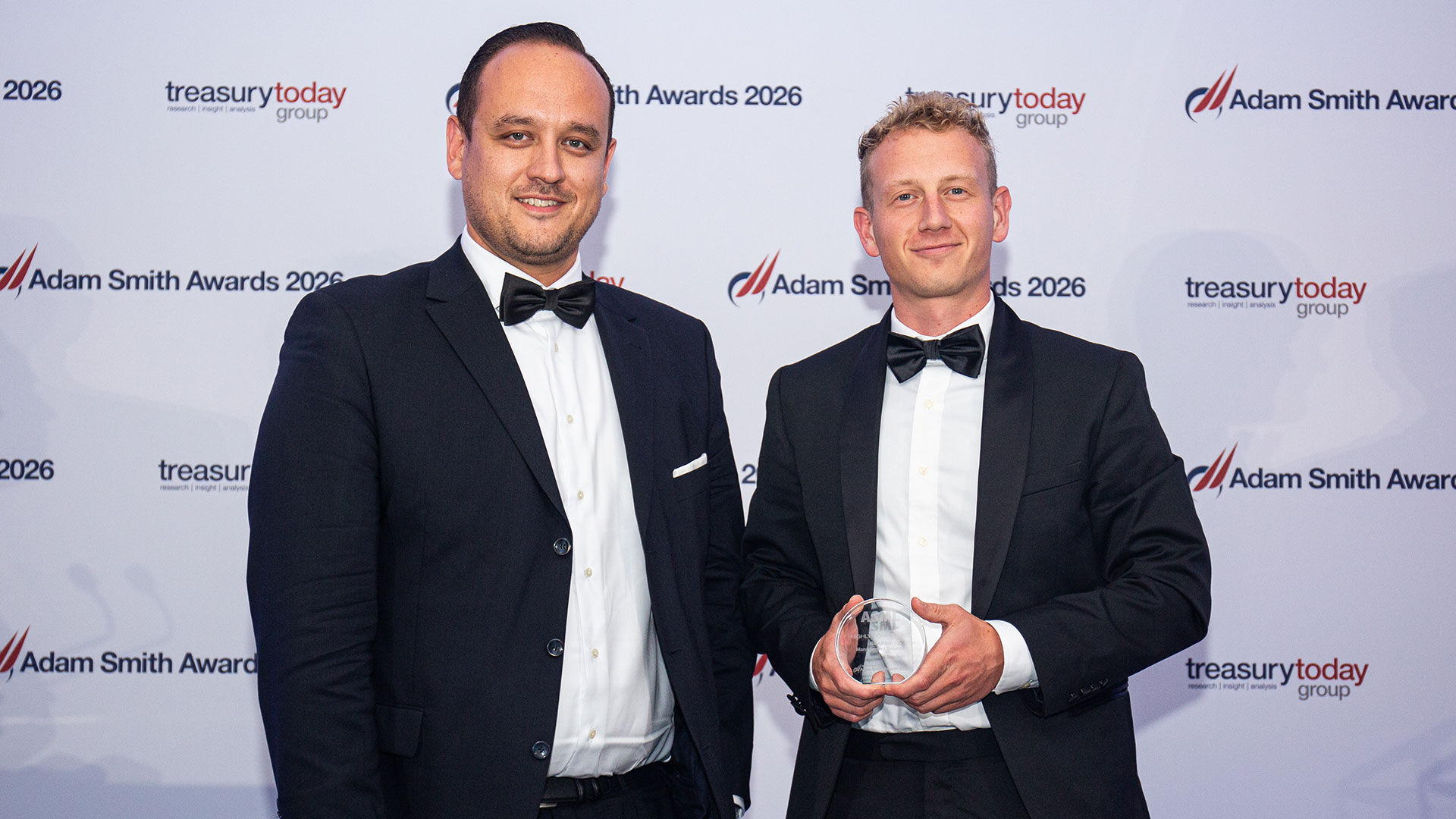
Photo of Glenn Bindels and Mark Van Eersel, ASML Netherlands BV.

Mark Van Eersel

Sr. Treasury Specialist
ASML logo
The Netherlands

ASML Netherlands BV, headquartered in Veldhoven, Netherlands, is a global leader in the semiconductor industry. They manufacture highly complex lithography systems used by companies like TSMC, Intel and Samsung to mass‑produce microchips. These massive, multimillion-dollar machines use ultraviolet light to imprint intricate transistor patterns onto silicon wafers.

The challenge

Before implementation, exposure measurement was largely manual and static, relying on MS Excel based processes. Data was fragmented across regions, with different data owners and systems, maintaining separate datasets and no central database providing a consolidated global view. As a result, transparency and timely oversight of total counterparty exposure were limited.

The framework also lacked completeness: indirect exposures via money market funds were not included, and letters of credits were not captured in an automated way, at best updated monthly. ASML faced growing limitations in its counterparty credit risk framework and exposure management processes. The existing treasury policy relied on static counterparty limits primarily linked to short-term credit ratings. While appropriate at the time of design, this approach became increasingly misaligned with fast moving financial markets.

Credit ratings are backward looking and slow to react, offering limited early warning capability during periods of stress. In addition, fixed limits did not reflect the significant growth and volatility in ASML’s cash position, resulting in frequent ad hoc requests for temporary limit increases and reduced agility.

The solution

The solution implemented was a dynamic counterparty exposure management framework, centred on automated daily exposure visibility and responsive limit setting. The core of the solution is a centralised exposure management and dashboarding capability that links counterparty credit limits to two continuously changing variables: end of day credit default swap (CDS) spreads of financial counterparties and ASML’s total available cash position.

By combining market-based CDS data with daily cash balances, the solution delivers forward looking risk signals and automatically scales counterparty limits in line with balance sheet movements. This ensures that total exposure, diversification and concentration risk remain aligned with the company’s real risk profile on a day-to-day basis.

Implementation focused on embedding daily exposure monitoring into standard treasury operations. Key elements included automating the daily ingestion of CDS data via the TMS data interface, centralising global exposure data, and visualising both limits and actual exposures through business intelligence dashboards, using Spotfire and information links in the data warehouse.

The result is a scalable, automated and proactive exposure management solution that enables treasury to manage counterparty risk in real-time.

Best practice and innovation

The judges commended ASML for overhauling cash management with an in-house solution based on automated daily exposure visibility and responsive limit setting to transform management of the cash position.

The solution demonstrates best practice and innovation by shifting counterparty risk management from periodic, static reporting to fully automated, real-time exposure management. Rather than assessing risk monthly or ad hoc, the framework recalculates counterparty limits and total exposures on a daily basis, reflecting the reality that financial risks evolve every day, not at month end.

At the core of the innovation is a centralised real-time dashboard that combines daily cash balances, automatically updated counterparty limits and actual exposures in one global view. As ASML’s cash position is highly volatile, fixed limits quickly become outdated. The solution automatically adjusts limits each day in line with cash movements, ensuring that concentration and diversification risks remain appropriate at all times.

Key benefits

  • Process efficiencies.

  • Risk mitigation.

  • ure-proof solution.

  • Improved key performance indicators (KPIs) or metrics.

  • Improved visibility.

  • Increased automation.

  • Increased system connectivity.

  • Manual intervention reduced.

  • Reduction in errors.

The solution delivered a dynamic, automated and scalable counterparty risk and exposure management framework that aligns risk control with both ASML’s balance sheet and real time market conditions.

A key objective was to optimise risk adjusted returns while maintaining strong risk discipline. By dynamically adjusting limits based on daily cash balances and counterparties’ CDS spreads, treasury can allocate more exposure to banks that are best able to absorb risk. This has enabled improved diversification and better investment conditions, particularly at peak cash moments such as year end, resulting in higher yields without increasing overall risk appetite.

Operational efficiency was another core aim. The automated, daily recalculation of limits has eliminated the need for ad hoc limit increase requests and manual approvals, including CFO sign offs.

This solution fundamentally changed how treasury professionals make decisions, use cash and manage risk daily.

Adam Smith Awards sail

The Adam Smith Awards are the industry benchmark for best practice and innovation in corporate treasury. The 2026 awards attracted 635 nominations. To find out more please visit treasurytoday.com/adam-smith-awards

Join our global community

Creating a free account helps us to understand our community better, and tailor our content and events to suit your needs. You can unsubscribe at any time.

Already have an account? Sign in

Search for your company; if not found, select 'Other' and enter it manually below
  • • At least 8 characters
  • • At least 1 uppercase letter (A-Z)
  • • At least 1 lowercase letter (a-z)
  • • At least 1 digit (0-9)