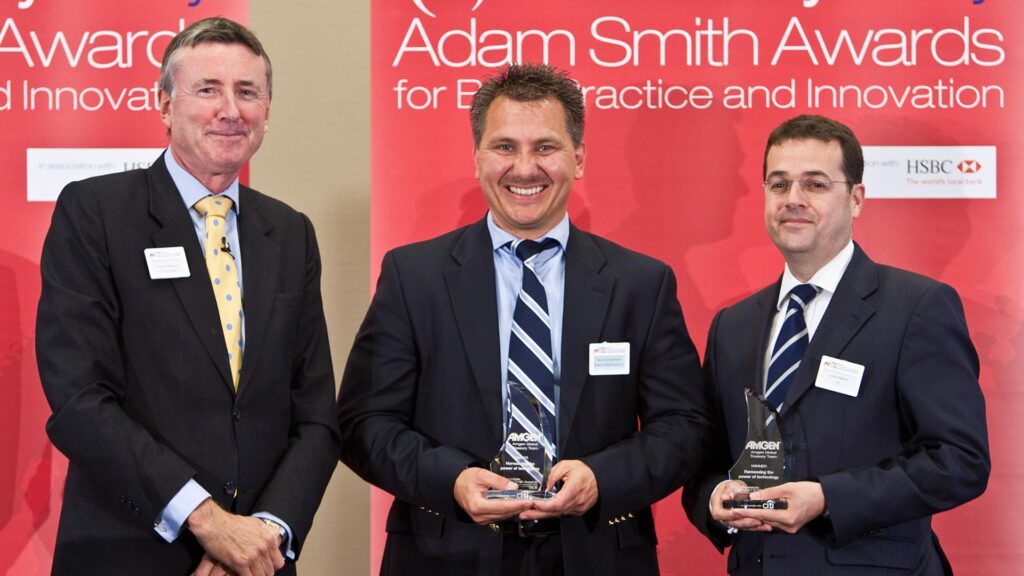
Outside of the US, Amgen’s treasury operations are carried out by Amgen Global Finance BV, the company’s global in-house bank located in the Netherlands. By setting up its financial services company in 2006, Amgen completed the first phase of its treasury transformation strategy: the centralisation of the treasury. In 2007, Amgen entered into the second phase: treasury system implementation.
However, during Amgen’s global implementation of the SAP ERP system, it became clear that different systems were in place for the company’s cash pooling, global netting, inter-company lending and payments factory processes, all of which required different interfaces to connect with SAP.
In addition, the complex and inefficient reconciliation structure precluded the simultaneous operation of Amgen’s global netting and hedging programmes, leading to increased FX costs and requiring multiple bank accounts to be maintained. “We used to be an accounting driven finance organisation,” comments Marco Schuchmann, Director and International Treasury Manager. “Our netting process required manual up- and downloads of data to/from various legacy systems and we maintained a subset of bank accounts which only had transactions once per month. In addition, we sold currencies during the netting that we bought back a couple of days later in order to offset hedging contracts.”
In restructuring the company’s treasury function, it was hoped that the number of interfaces could be reduced, the number of bank accounts streamlined and the global netting and FX processes aligned. Another goal was to align processes with those carried out by the US treasury.
The project was undertaken in collaboration with SAP and Citi, Amgen’s main international banking partner. “The solution centred on the setting up of a sub-ledger, SAP-IHC (In-House Cash) in Amgen’s core ERP system,” says Marco Schuchmann. “This allows us to bring together all aspects of in-house banking. In addition, we are optimising our cash flow and foreign exchange management, allowing Amgen to book largely accounting entries and ensuring that those transactions executed via our banking partner are 99% ACH payments.”
“Cost savings of $2m per year have been achieved as a result of reducing the volume of cash flows through the bank accounts, streamlining external payments and reducing FX transactions.”
In order to ensure the project’s success, Amgen involved a number of the company’s departments. “We had a very challenging timeline of 12 months for the global implementation. As such, a comprehensive change management programme was developed internally to keep all relevant parties updated, with representation from Accounting, Tax and Legal as well as HR,” reports Marco Schuchmann. This programme was used to inform senior management about organisational changes, analyse staff support levels, identify training needs, handle security administration and evaluate issues regarding segregation of duties.
The long-term hedging programme established as part of the solution has enabled balance sheet and profit and loss (P&L) exposures to be 100% hedged, while external FX transactions have been reduced. Meanwhile, no interfaces are required of the company’s in-house banking processes as they are 100% integrated in SAP. The number of bank accounts has been reduced by around 30% and netting and hedging timelines have been aligned. Cost savings of $1m per year have been achieved as a result of reducing the volume of cash flows through the bank accounts, streamlining external payments and reducing FX transactions. In addition, the SAP user profiles set up for each user have been used to define individuals’ roles and responsibilities more clearly.
A recent internal audit confirmed that SAP-IHC has been working perfectly since implementation, and Marco Schuchmann is delighted with the solution’s success: “This project is a perfect showcase of how SAP technology can leverage business processes by offering a truly integrated solution.”