
Supply shocks and deglobalisation signpost higher interest rates ahead
Published: Apr 2026
Supply shocks, deglobalisation and a changing world order are raising the likelihood of higher and more volatile inflation in the coming years. This will make it more difficult for central banks and governments to use fiscal and monetary policies to smooth the economic cycle and limit the negative effects of downturns. It means more upward pressure on (real) interest rates and greater economic and financial market volatility.
Since Keynes and Milton Friedman developed their theories, governments and central banks have sought to steer the demand side of the economy. For a long time, it was assumed that if there was too much demand in the economy (ie inflation), demand would first need to be curbed, but that supply would eventually increase. After all, there is money to be made.
In recent years, however, the world has increasingly been confronted with supply shocks: COVID-19, the war in Ukraine, and now the war in the Middle East, including the closure of the Strait of Hormuz. Governments and central banks are far less equipped to deal with this. They can do almost nothing to rapidly increase supply. The only thing they can do, therefore, is curb demand so that equilibrium is restored at a lower level.
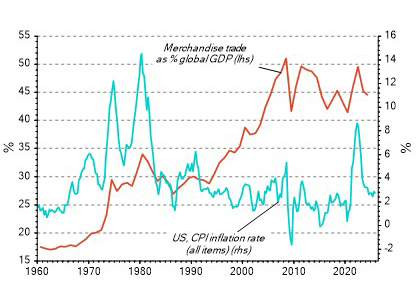
To illustrate this clearly, let us briefly look back in time. Under the leadership of President Reagan and Margaret Thatcher, the West shifted its focus in the late 1970s from primarily stimulating demand to stimulating supply. This was done to combat inflation. Then, in the late 1980s and early 1990s, the fall of communism occurred. This soon coincided with the rise of the internet. As a result, countries like China suddenly had access to the most modern technologies at virtually no cost.
Chart 1: Globalisation has put inflation under downward pressure in the past decades
Source: LSEG Datastream/ECR Research
This quickly led to globalisation. In other words, the West was increasingly flooded with cheap imports from emerging economies. Additionally, globalisation created a global surplus of labour. Consequently, downward pressure on prices and wage growth intensified.
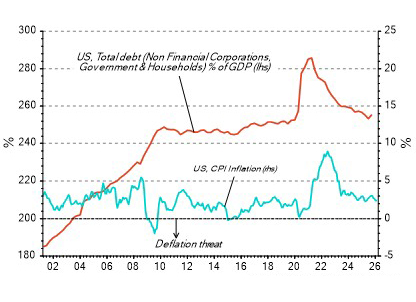
Whereas the 1960s and 1970s saw rising inflation, this shift caused the economic climate to move increasingly toward deflation. In the eyes of central banks, this posed a major threat, as both the private sector and governments had accumulated enormous debts by that point. The combination of high debt and deflation is devastating for an economy.
Chart 2: In 2008 and 2020, deflationary forces in the economy were a big threat given the huge debt levels
Source: LSEG Datastream/ECR Research
Economic policy therefore shifted once again: from stimulating supply back to stimulating demand. Unfortunately, this shift was not so much about becoming more competitive relative to emerging economies, but primarily about further increasing debt. This is a crucial point, because it meant that any slight dip in demand was immediately met with fiscal and monetary stimulus. Otherwise, given the high levels of debt, deflation and an economic crisis would have quickly ensued.
For investors in stocks, bonds and real estate, this became crucial. As a result, every significant drop in asset prices has consistently presented a good buying opportunity. Even during the tenure of Fed Chair Greenspan, people spoke of the so-called “Greenspan put”, and this pattern remained visible long after his term ended.
The old approach no longer works
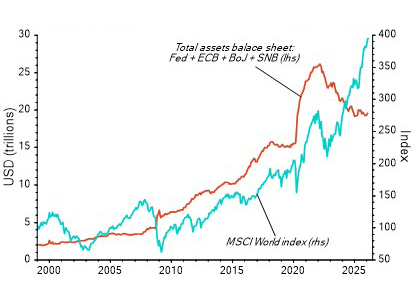
Many of today’s asset managers grew up and worked in this environment. They have experienced little else than asset prices eventually rising to new highs time and again. This was mainly because policies were increasingly pursued in which more money was created than the economy could absorb. The excess money then flowed into asset markets, driving up the prices of stocks, bonds and real estate ever higher. Thus, high levels of debt were offset by higher asset values, making it possible to borrow again.
Chart 3: Central banks' QE programs have largely contributed to the enormous price rises in risky assets since 2009
Source: LSEG Datastream/ECR Research
The conclusion that can be drawn is that, in the event of a decline in economic growth, resorting once again to substantial fiscal and monetary stimulus will be of limited help. In these circumstances, higher growth would quickly lead to bottlenecks and higher inflation. This is all the truer now that the world order is changing.
New world order
New technology is radically changing the nature of warfare. Technological developments, including drones, make it possible for a country like Ukraine to withstand Russian aggression for years, and for Iran to keep the Strait of Hormuz closed despite US military superiority. This development is accompanied by massive shifts in power. Countries that were very powerful until recently are rapidly losing importance, while others are gaining influence.
Iran is a clear example here. From a military standpoint, the country is not particularly formidable and is no match for its enemies, Israel and the US. In order to restore the balance of power in the Middle East, Iran has long sought to acquire a nuclear weapon, which was intended—at the very least—to deter attacks from the US or Israel.
However, due to recent actions by Israel and the US, that nuclear ambition—to the extent it ever existed—has largely evaporated. At the same time, it has become clear that Iran possesses an economic “nuclear weapon”: the ability to hold the global economy hostage by closing the Strait of Hormuz.
The closure of Hormuz has caused energy prices to rise, which has two major effects: rising inflation and lower economic growth due to declining consumer purchasing power. The latter calls for stimulus, but that would drive inflation even higher, as it would allow producers of energy-intensive goods to pass on their higher costs fully to consumers.
Conclusion
Increasing risks of supply shocks, a changing world order and an expected process of deglobalisation are raising the likelihood of higher and more volatile inflation in the coming years. This will make it more difficult for central banks and governments to use fiscal and monetary policies to smooth the economic cycle and limit the negative effects of downturns. Consequently, we expect, on balance, more upward pressure on (real) interest rates and greater economic and financial market volatility.