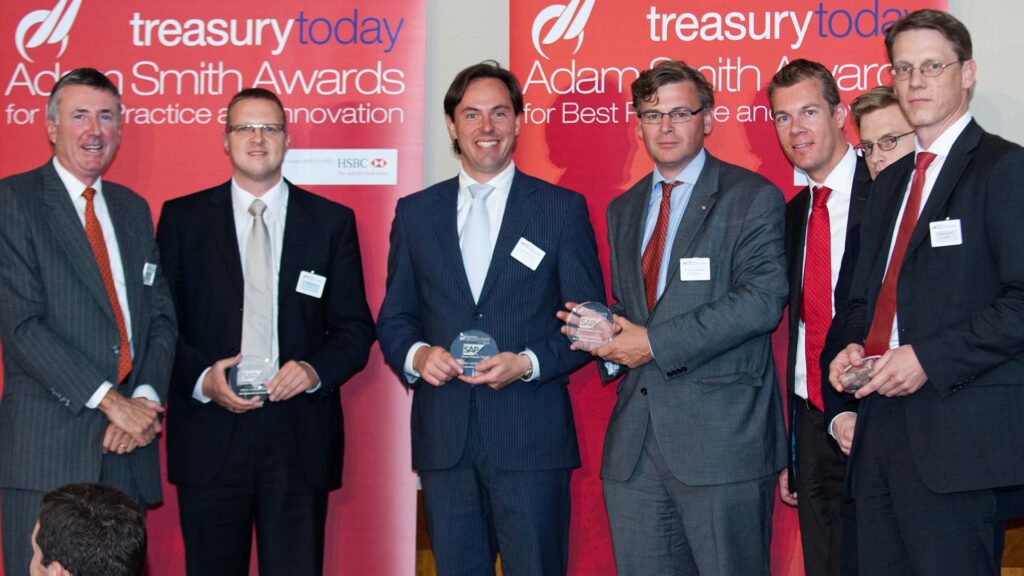
In 2009, SAP AG successfully executed a private placement transaction (German Schuldschein) worth approximately €700m. The goal was to prudently increase cash reserves and to secure a minimum operating group liquidity of €1.5 billion. Having reached a comfortable group liquidity level by the end of 2009, SAP continued its proactive approach to financing by aiming to raise liquidity in order to enhance its strategic flexibility in the future. A prolonged period of decreasing credit spreads, historically low interest rate levels, exceptional investor demand for high quality corporate paper and the development of the European unrated bond market created the ideal market backdrop for SAP.
As Steffen Diel, Head of Treasury Finance, Global Treasury, SAP AG states, “We decided to tap the market via an unrated corporate bond issue, the first public bond transaction in the company’s history. The target volume of €750m (+/- €250m) was ambitious given the unrated status of the issuer.”
After careful internal preparation, a group of four banks (BNP Paribas, Deutsche Bank, ING and J.P. Morgan) was appointed by SAP to assist on the project. The SAP team was able to finalise the prospectus preparation and approval process within four to five weeks. A two-day road show with a global conference call was conducted by two separate teams including the CFO and representatives from treasury and investor relations.
Following a short, but intense soft market sounding phase, SAP together with its book-runners decided to offer a four year and a seven year tranche with benchmark volume (€500m or higher) each. Investor demand was overwhelming. The aggregate indication of interest was around €7 billion without having released a price guide. The order book was finally closed after only 13 minutes and contained most of the reputable, high quality European investor accounts.
“The deal marks the lowest spread seen by an unrated issuer since Porsche in 2006 and the tightest unrated deal priced relative to market levels.”
Diel explains, “This exceptional investor reception coupled with a strong order book volume (an aggregate of €10 billion) allowed SAP to squeeze pricing and to print both tranches tighter than initial price guideline. With spread levels of 45 basis points (four years) and 70 basis points (seven years), the deal marks the lowest spread seen by an unrated issuer since Porsche in 2006 and the tightest unrated deal priced relative to market levels.”
SAP tapped the debt capital markets with its inaugural bond transaction at an ideal point in time. In an historically low interest rate environment SAP took advantage of a debt market where investor demand for corporates with a high credit quality was extraordinarily strong. With coupons as low as 2.50% (4 years) and 3.50% (seven years), the company managed to achieve pricing levels close to secondary market levels of established, blue-chip European borrowers in the mid-to-high single A-rating category. During the first few days after the transaction, credit spreads of the bonds further tightened.
For SAP, this is a tremendously important benchmark in the capital market which reflects the company’s compelling credit story, based on its reliable, sustainable and successful business model, its high equity ratio and the strong recurring cash flows. By successfully placing this benchmark with high quality European investors, SAP has gained access to an important potential future source of debt capital.
“This project is a very good example of how the treasury department can proactively realise favourable debt capital market transactions at attractive financing costs in order to enhance the company’s strategic options in the future,” concludes Diel.