Best Card Solution Winner: Honeywell International Inc
Published: Aug 2010
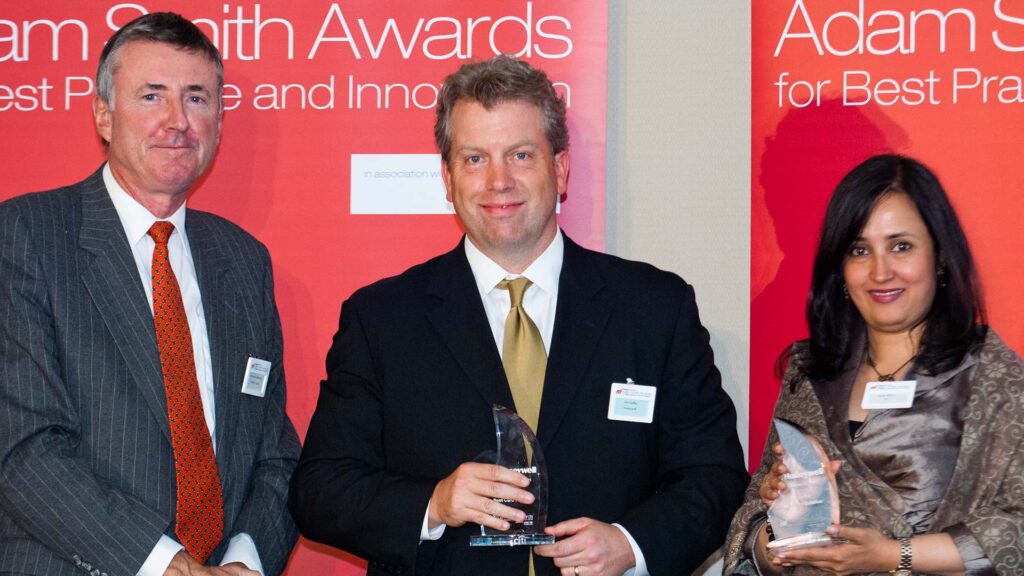
Photo of Richard Parkinson, Jim Colby from Honeywell accepting on behalf of Michael Suriano and Swati Mitra, Citi.
Michael Suriano
Director – Corporate and Structured Finance
Honeywell International Inc. is a Fortune 100 diversified technology company, serving customers worldwide with aerospace products and services, control technologies for buildings, homes and industry, automotive products, turbochargers and speciality materials.
in partnership with
With the majority of Honeywell’s employees located outside the United States and more than 40,000 employees travelling and/or entertaining (T&E) globally as part of their job responsibilities, it is critically important for these employees to have a convenient and cost effective mechanism to pay for their T&E expenses. For over two decades, Honeywell had been utilising a single provider for all of its T&E credit card business globally, excluding China.
In early 2009, a multi-functional team, which included corporate treasury, conducted a formal Request for Proposal (RFP) to evaluate best in class card providers and to determine which credit card (Amex, Visa, MasterCard, etc.) and financial institution had the most attractive offering.
In June 2009, the team chose Citi’s MasterCard offering as Honeywell’s global corporate card. Honeywell’s treasury, legal and procurement functions then negotiated a common template of general terms and conditions and country/regional programme schedules to address local regulatory and service requirements. A single schedule encompassing all financial terms was negotiated. Country/regional addenda were negotiated sequentially.
As a new addendum was executed, new cards were issued in that country/region so that all 40,000 cards did not need to be replaced simultaneously. While this strategy resulted in a slightly longer implementation cycle and a slight delay in realising all of the operational and financial benefits of the new offering, Honeywell chose this strategy to minimise the perceived high risk of a simultaneous global rollout. In this way, any lessons learned from one implementation could be applied to subsequent deployments.
Michael Suriano explains, “Because so many credit cards needed to be replaced in over 40 countries, Honeywell’s IT group developed a new credit card portal for employees to request and their manager to approve the issuance of the new credit card. The credit card portal also provided a central repository of all employee credit card data.”
Citi’s MasterCard offering provided a multi-million dollar incremental benefit over the life of the contract when compared to Honeywell’s current solution. It is expected that over 90% of global T&E spending will now be paid using the new corporate credit card, resulting in improved cardholder satisfaction and an improvement in merchant spend data. In addition, an increase in corporate card utilisation will reduce the need for employees to request relatively expensive cash advances and minimise the risk of cash being lost or stolen. The solution also strengthened the relationship between Honeywell and one of its key global relationship banks.
Using six-sigma tools and working as a multi-functional team, Honeywell was able to quickly move from RFP preparation to final implementation. The new corporate credit card will improve merchant acceptance by approximately 20%, while providing multi-million dollars of incremental financial benefit. Capturing additional credit card spend data will additionally allow Honeywell procurement team to negotiate improved purchasing terms. “The new corporate credit card now allows Honeywell to better monitor compliance with global T&E policies thus reducing overall T&E spend. Business traveller satisfaction has also improved,” says Suriano. “This is critical as Honeywell continues to make a strong effort to grow revenue in emerging markets where new sales opportunities often require face-to-face meetings to win the business.”
The Adam Smith Awards is the industry benchmark for best practice and innovation in corporate treasury. To find out more please visit treasurytoday.com/adam-smith-awards
Creating a free account helps us to understand our community better, and tailor our content and events to suit your needs. You can unsubscribe at any time.
Creating a free account helps us to understand our community better, and tailor our content and events to suit your needs. You can unsubscribe at any time.